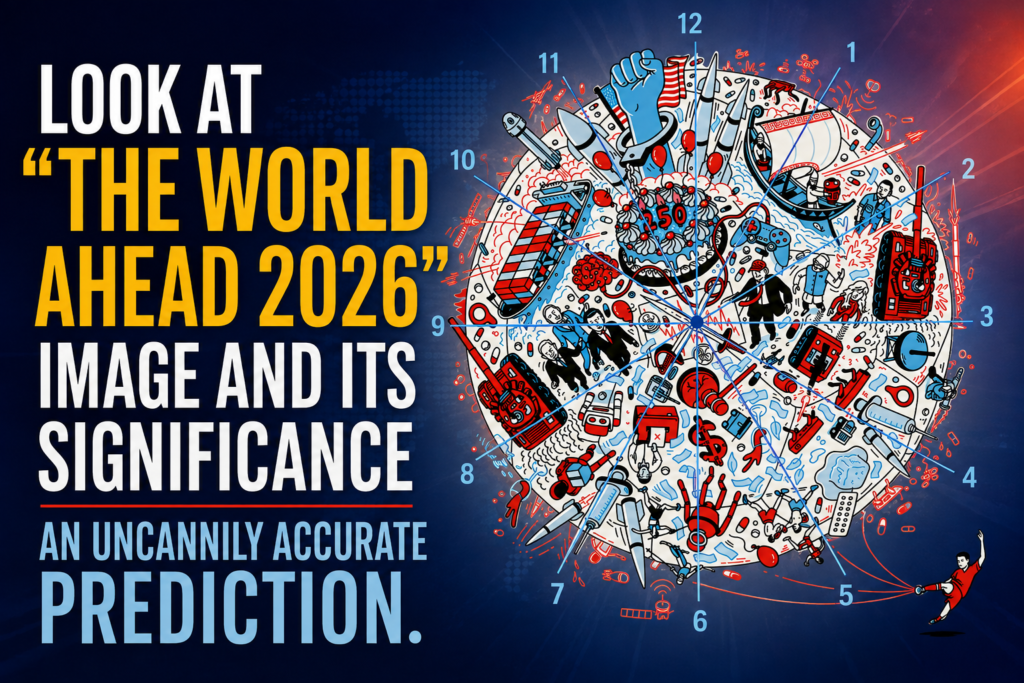
There is a fascinating way to look at this image.
Instead of seeing it as nothing more than a chaotic collage of missiles, oil tankers, robots, medicine, money, politicians, soccer, natural disasters, and strange mechanical objects, imagine the entire illustration as a clock.
The clock begins at number 1, moves through 2, 3, 4, and so on, until it reaches 12.
Now draw a line from the center of the image toward each number.
Suddenly, every section of the picture becomes a possible “time marker.” The objects sitting near each line can be interpreted as the dominant themes of that month.
That makes the 2026 cover of The Economist’s “The World Ahead 2026” particularly fascinating. The magazine itself presents the annual issue as a look at the trends and events likely to shape the year, while outside analyses have also noted that the cover is better understood as a visual map of interconnected global forces than as a literal prophecy.
Video August 2026 #nepal – Look “The World Ahead 2026” Image and Its Significance — Accurate Prediction:
But there is another way to test the image.
Take each section of the illustration, assign it to a month, and then compare the symbols with what actually happened in the real world.
That is when things start getting uncanny.
There is one important distinction, though.
For January through August 2026, we can compare the image with events that have already happened. For September through December, we are entering the realm of forecasts and possible scenarios. As of August 29, 2026, those four months have not happened yet.
So this is not a claim that the image literally predicted the future.
It is something more interesting:
What happens when we use the image as a 12-month map and then compare its symbols with the world as it unfolds?
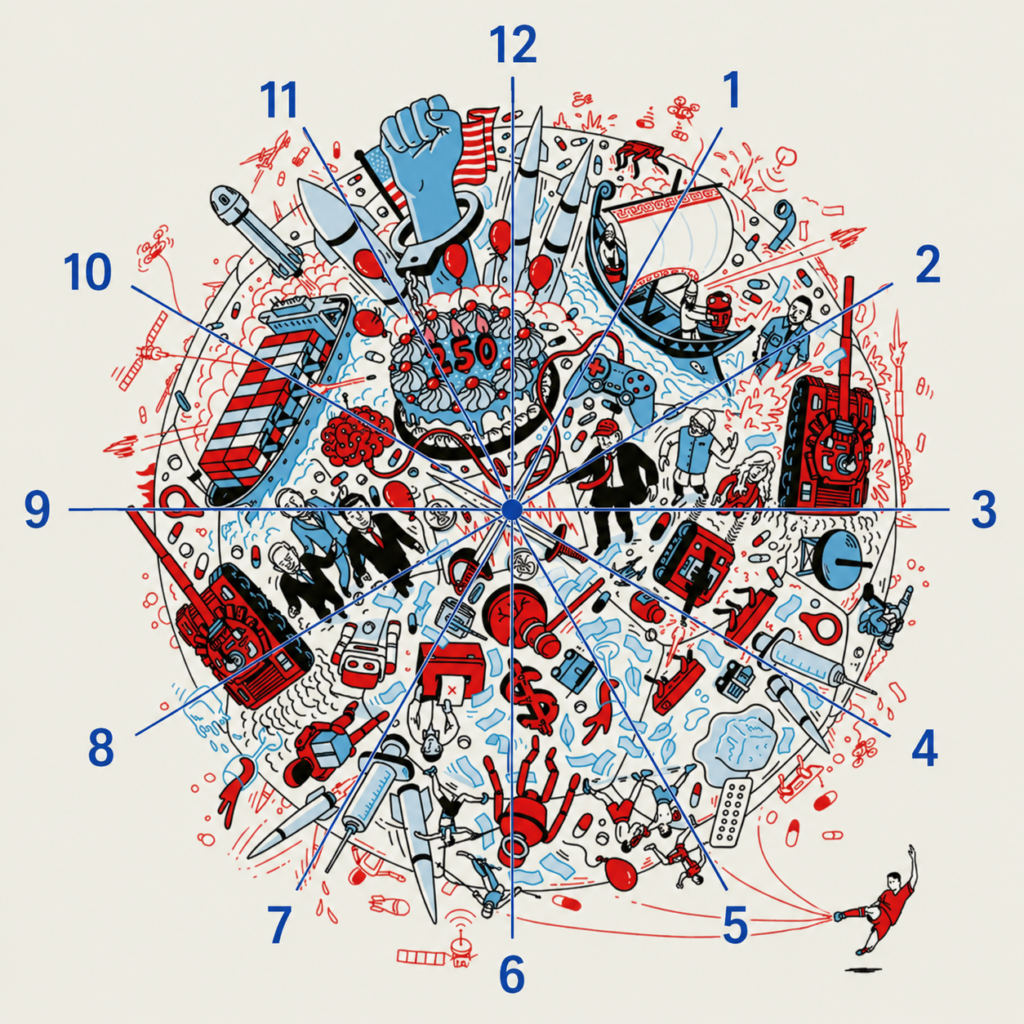
And once we do that, the connections become surprisingly difficult to ignore.
JANUARY — MISSILES, OIL TANKERS AND ROBOTS: THE YEAR BEGINS WITH PHYSICAL AI AND ENERGY
The clock points to number 1.
Right around this section of the image, we see missiles, objects resembling weapons, a ship, mechanical structures, and a robot-like machine.
Individually, none of these symbols seems particularly unusual.
But put them into January 2026, and the picture becomes much more interesting.
The first major technology event of the year was CES 2026 in Las Vegas.
And the big story was not simply artificial intelligence.
AI was beginning to leave the screen.
At CES 2026, “physical AI” — AI embedded into robots, humanoids, autonomous machines and physical systems — became one of the major themes. Reuters described CES as a moment when AI was increasingly moving from software into the physical world.
CES also featured discussions about humanoid robots and how machines with human-like bodies could change factories, warehouses and eventually everyday life.
And then there were the robot dogs.
On January 5, Hyundai demonstrated a robot dog on stage at CES in a K-pop performance, while Boston Dynamics’ Atlas humanoid robot was also presented as part of the growing push toward commercially useful humanoid machines.
That makes the robot imagery near number 1 particularly striking.
The robot is no longer sitting quietly inside a laboratory.
It is walking onto a stage.
It is moving.
Running.
Interacting.
Performing.
But why are missiles and an oil tanker sitting so close to the robots?
Because the deeper message of the image is that technology and warfare can no longer be treated as completely separate stories.
The original analysis of the cover describes war as a persistent feature of the modern world and places AI, robotics, logistics, manufacturing and military power within the same interconnected system.
In other words, the robot in January is not just a robot.
It represents the automation of the physical world.
And the oil tanker represents something equally important:
Energy.
That is the paradox.
Humanity can build humanoid robots, advanced AI models and autonomous machines, yet the global economy can still be shaken by a narrow waterway through which oil and gas must pass.
A civilization can build machines that think.
But it still needs ships to move fuel.
That is the first clue to understanding the entire image.
Technology may be advancing at extraordinary speed, but the old physical infrastructure of the world still matters.
FEBRUARY — WHEN MISSILES BECOME REAL: WAR IS NO LONGER SOMETHING HAPPENING SOMEWHERE ELSE
The clock moves to number 2.
This section contains another unmistakable group of symbols: military imagery, weapons and figures caught inside a chaotic environment.
If January feels like the technological opening act, February feels like the warning siren.
On February 28, 2026, Israel said it had launched a preemptive attack against Iran, marking a dramatic escalation in the conflict surrounding Iran’s nuclear program and ballistic-missile capabilities.
And suddenly, the missiles in the image look much less abstract.
The original interpretation of the cover describes war as something that has become almost permanent rather than a single isolated event.
Not one war.
Multiple conflicts.
Ukraine.
The Middle East.
The Red Sea.
Taiwan.
The Caucasus.
The Sahel.
The point is not necessarily that every one of these conflicts will explode into a major war.
The more unsettling possibility is that many of them can simply continue.
Long wars.
Frozen conflicts.
Proxy wars.
Drone attacks.
Missile exchanges.
Cyber operations.
Economic sanctions.
The original analysis argues that modern conflicts do not necessarily need a decisive final battle. They can become prolonged wars of attrition that continue affecting defense budgets, weapons manufacturing, supply chains and diplomacy.
That makes February the month of the missile.
But the missile is only the beginning.
Because every missile carries an economic consequence.
Higher oil prices.
Higher shipping costs.
Higher insurance premiums.
Higher inflation.
And eventually, higher political pressure.
That is the deeper idea hidden in the illustration.
War does not stay inside the military section of the picture.
It spreads into everything else.
MARCH — THE STRAIT OF HORMUZ: WHEN ONE SHIPPING ROUTE CAN SHAKE THE ENTIRE WORLD
The clock reaches number 3.
This is one of the most interesting sections of the entire illustration.
Ships.
Energy.
Industrial equipment.
Military imagery.
Economic symbols.
And in March 2026, the real world produced an event that fits this section almost perfectly:
The Strait of Hormuz.
The conflict involving Iran severely disrupted shipping through the strait. On March 5, Reuters reported that China was negotiating with Iran over safe passage for oil and LNG vessels. Reuters cited data showing that oil-tanker traffic had fallen from roughly 24 vessels a day to just four, while hundreds of ships were stranded in the region.
Roughly one-fifth of the world’s oil and LNG supply normally passes through this narrow waterway.
That is why the tanker in the image should not be interpreted simply as “a ship.”
It represents the global supply chain.
It represents oil.
It represents inflation.
It represents globalization.
And, perhaps most importantly, it represents dependence.
By March, the conflict had pushed oil prices above $100 a barrel at points as shipping through the Gulf was disrupted, while the International Energy Agency moved toward a major emergency release of oil reserves to help stabilize supply.
Think about what that means.
A conflict thousands of miles away can affect gasoline prices.
A shipping disruption can affect inflation.
Inflation can affect interest rates.
Interest rates can affect stock markets.
And stock markets can affect investment in technology.
That is the “systems” idea behind the illustration.
A war does not need to strike New York or London to create economic pain in New York or London.
Sometimes all it takes is a ship that cannot get through a strait.
APRIL — ROBOTS ARE NO LONGER JUST WALKING. THEY ARE ENTERING REAL INFRASTRUCTURE
The clock moves to number 4.
The imagery here becomes increasingly mechanical: robots, machinery, tools and industrial systems.
If January was about putting robots on a stage, April is about putting them to work.
On April 16, Reuters reported on Chinese multi-legged robots being developed for real-world tasks including patrols, power-line inspection, firefighting and infrastructure inspection.
That distinction matters.
Robots do not necessarily need to become “humans in metal suits.”
They can become machines that quietly enter environments where humans do not want to work.
Power stations.
Factories.
Construction sites.
Underground tunnels.
High-temperature environments.
Hazardous industrial facilities.
Places where a machine can operate longer, cheaper and more safely than a human.
That is consistent with the deeper argument in the original cover analysis.
The robot is not merely a symbol of science fiction.
It represents the convergence of manufacturing, labor shortages, logistics, military technology and automation.
There is another important implication.
A robot developed for a civilian factory can potentially contribute technologies, components, sensors and algorithms that are also useful in defense.
That means robotics can become a bridge between the civilian economy and national security.
So April is not really the “month of robots.”
It is the month of a much bigger question:
How much of the work humans do today will still be done by humans tomorrow?
MAY — ROBOT HANDS, MEDICINE AND THE HUMAN BODY: THE BATTLE MOVES INSIDE US
The clock points to number 5.
The imagery starts shifting from machines toward the human body.
Medicine.
Pills.
Medical devices.
Bodies.
And strange biological shapes.
This is the “human layer” of the illustration.
But May 2026 offers an interesting connection between the world of robotics and the world of biology.
On May 4, Reuters reported that Chinese startup Linkerbot, which develops highly dexterous robotic hands for humanoid robots, was targeting a valuation of around $6 billion. The company said it was increasing production capacity from roughly 5,000 to 10,000 robotic hands per month.
That is important because the robotics revolution is not really about the robot as a single machine.
It is about the hand.
The joints.
The motors.
The sensors.
The materials.
The ability to manipulate objects.
The ability to perform delicate tasks.
The smallest components can become the foundation of an enormous industry.
And sitting right next to those mechanical symbols in the image are pills.
That takes us into another theme from the original analysis: biopower.
The author argues that the human body is becoming another battlefield of economic and technological power — through weight-loss drugs, genetic technology, vaccines, healthcare, productivity and demographic pressures.
The question of power may therefore be changing.
The 20th century asked:
Who has more tanks?
The 21st century may increasingly ask:
Who has a healthier population?
Who can extend healthy life?
Who can improve human productivity?
Who controls biotechnology?
Who can afford advanced medicine?
Who can turn biological research into industrial power?
That is why the tiny pills in the image may be more important than they first appear.
A missile destroys something outside the body.
A drug changes something inside it.
JUNE — SOCCER, HORMUZ AND A WORLD THAT TEMPORARILY STOPS FIGHTING
The clock reaches number 6.
And here we encounter one of the most intriguing details in the entire image.
Near the bottom, a soccer player stands outside the main circle, apparently kicking an object back toward the system.
The original analysis gives this figure an important symbolic role.
The soccer player is not simply about soccer.
He represents culture, sports, soft power, public attention and the ability of a cultural event to influence politics and society.
And there was no larger sporting event in June 2026 than the FIFA World Cup.
The tournament began on June 11 and ran through July 19, with a record 48 teams competing across the United States, Canada and Mexico.
But June also contained another remarkable development.
War.
And a temporary ceasefire.
On June 15–17, the United States and Iran reached an agreement aimed at halting the war, with the arrangement also connected to reopening the Strait of Hormuz.
Oil flows through the strait subsequently recovered sharply, with Gulf oil exports rising by more than 3 million barrels per day in June compared with May as shipping activity began returning.
So why would soccer and war appear along the same conceptual line?
Because that is precisely the larger point.
In a world overloaded with crises, human beings do not live on geopolitics alone.
They watch soccer.
They follow celebrities.
They argue on social media.
They gather around cultural events.
They look for moments of collective excitement that allow them to forget, even temporarily, what is happening outside.
And sometimes culture can move faster than diplomacy.
A soccer match can capture billions of people’s attention.
A single player can become a global symbol.
A tournament can create a shared identity that politicians cannot manufacture.
The player outside the circle therefore becomes more important than he first appears.
He represents the human need for something beyond crisis.
JULY — THE “250” CAKE: AMERICA’S BIRTHDAY AND THE QUESTION OF POWER
The clock moves to number 7.
Here we find perhaps the most obvious symbol in the entire illustration:
A birthday cake marked “250.”
The number refers to the United States’ 250th anniversary in 2026.
But look carefully at the cake.
It is not sitting in a peaceful birthday scene.
Around it are missiles, machinery, political figures, money and technological symbols.
The original analysis interprets this as a visual contradiction: America remains an extraordinarily powerful country while simultaneously facing political polarization, institutional pressure, geopolitical competition and internal divisions.
July is therefore the month when this symbol reaches its peak.
July 4 is Independence Day.
But July 4, 2026, is not an ordinary Independence Day.
It marks 250 years since the Declaration of Independence.
That gives the cake a double meaning.
Celebration.
And anxiety.
The United States is celebrating its history while confronting questions about its future.
And the timing is even more interesting because the 2026 World Cup final took place on July 19 at MetLife Stadium in the New York/New Jersey area.
One side of the month is America at 250.
The other is the world’s biggest sporting event reaching its conclusion on American soil.
The soccer player outside the circle suddenly becomes more meaningful.
The world is watching America.
But America is also watching itself.
That is the contradiction.
The country is simultaneously a nation, a superpower, a market, a political system and a global cultural stage.
AUGUST — WHEN ROBOTS RUN FASTER THAN HUMANS, DRUGS ENTER NEW MARKETS, AND CLIMATE HITS INFRASTRUCTURE
The clock reaches number 8.
This may be the point where the illustration begins to look less like a picture and more like an overloaded machine.
Robots.
Medicine.
Water.
Natural disasters.
Humans.
And August 2026 has produced several developments that make these symbols remarkably relevant.
On August 28, Reuters reported that China’s Tiangong Ultra humanoid robot (China robot) completed a 100-meter race in 8.64 seconds, beating Usain Bolt’s 9.58-second world record.
But immediately after the race, the robot reportedly struggled with perception and crashed into a wall.
That may be one of the most perfect metaphors for the entire AI era.
Machines are getting incredibly fast.
But they still do not necessarily understand the world the way humans do.
At the same time, Beijing hosted the World Humanoid Robot Games, with more than 2,000 robots competing in 51 events, while the World Robot Conference displayed around 3,000 robotic products.
The robot revolution is clearly moving beyond laboratory demonstrations.
But August was not just about robots.
On August 28, the FDA expanded approval of Eli Lilly’s Mounjaro for reducing cardiovascular risk in certain high-risk patients, another step in the rapidly expanding GLP-1 drug market.
In China, Novo Nordisk also submitted an application for regulatory approval of oral Wegovy.
And then there was climate.
Heavy flooding hit parts of China in August, affecting tens of thousands of people.
In Nepal and the Tibet border region, severe landslides and flooding connected to glacial collapse created another devastating disaster.
And then, once again, we return to the oil tanker.
By late August, shipping traffic through the Strait of Hormuz had fallen sharply, with only seven cargo vessels passing through on one day compared with a 10-day average of 15.
August therefore looks like a miniature version of the entire illustration.
AI.
Robotics.
Medicine.
Climate.
War.
Energy.
Economics.
Everything colliding at once.
That is exactly what the original analysis means by “coupling” — the idea that modern crises are increasingly interconnected rather than isolated.
And this may be the most important message in the entire picture.
SEPTEMBER — WHEN MARKETS BEGIN TO SEE THE PRICE OF EVERYTHING
From September onward, we enter the predictive section.
We should not say that these events have already happened.
Instead, we can ask what the image may be pointing toward based on the risks already developing.
The line toward number 9 passes through imagery associated with political power, weapons, money and instability.
This looks like economic fragility.
And September 2026 already has a remarkably clear setup.
Reuters reported on August 28 that global markets were entering September facing a cluster of risks: inflation, high government debt, the continuing Iran conflict, oil and gas volatility, central-bank meetings and political uncertainty in Europe and the United States.
The Federal Reserve is scheduled to meet September 15–16.
That decision is no longer simply a story about interest rates.
It is connected to oil.
Oil is connected to Iran.
Iran is connected to Hormuz.
Hormuz is connected to shipping.
Shipping is connected to inflation.
Inflation is connected to interest rates.
And interest rates are connected to financial markets.
That is the circle.
There is another fascinating possibility.
Anthropic is expected to publicly unveil its IPO prospectus after Labor Day, potentially setting up a major public-market test for one of the world’s most important AI companies. Reuters reported that the company could seek a valuation of up to $1 trillion.
If that happens, September could become a test of something much bigger than one company’s valuation:
Does AI actually generate enough economic value to justify the enormous capital being poured into it?
Or are financial markets pricing a future that has not arrived yet?
That is where the brain and the dollar in the illustration meet.
AI creates capability.
Markets decide what that capability is worth.
OCTOBER — AI, MONEY AND THE QUESTION: IS AI MAKING THE ECONOMY STRONGER OR CREATING ANOTHER BUBBLE?
The clock points to number 10.
The imagery here contains ships, industrial equipment, missiles and mechanical systems.
It feels intensely industrial.
This could be the month of productive capacity.
One of the deeper arguments in the original analysis is that the global economy is moving away from a pure obsession with efficiency and toward resilience.
AI.
Robots.
Semiconductors.
Energy.
Critical minerals.
Factories.
All of these are becoming strategic infrastructure.
The Federal Reserve is scheduled to meet October 27–28.
Meanwhile, the IMF is expected to update its global economic outlook in October.
The larger economic question is becoming increasingly complicated.
If energy prices remain volatile, inflation can return.
If inflation returns, central banks have less room to cut rates.
If borrowing costs stay high, governments face greater pressure from debt.
If governments spend heavily on defense and infrastructure, deficits can increase.
And if companies continue spending enormous amounts on AI infrastructure, investors will eventually demand evidence that those investments produce real economic returns.
This is why the industrial imagery around number 10 matters.
The future will not be determined only by who has the best AI model.
It may also be determined by:
Who owns the factories?
Who controls the chips?
Who has reliable energy?
Who can manufacture robots?
Who has access to critical minerals?
Who can maintain production when supply chains are disrupted?
That is closely connected to the original analysis’s argument that physical capacity itself is becoming a form of power.
In an unstable world, the ability to keep producing may matter almost as much as the ability to innovate.
NOVEMBER — ELECTIONS, CLIMATE AND THE BATTLE TO CONTROL THE STORY
The clock moves to number 11.
This section is surrounded by political imagery, weapons, fists and symbols of social conflict.
If we had to give November one word, it would be:
Power.
The United States enters the November 2026 midterm elections with all 435 House seats and roughly one-third of the Senate seats up for election.
That makes November an obvious political pressure point.
But there is another event that fits the imagery almost perfectly:
The United Nations climate conference is scheduled to take place in Antalya, Türkiye, from November 9 to November 20, 2026.
That creates an interesting symbolic connection.
In the image, climate does not sit inside a separate box.
It spills into everything else.
Water.
Fire.
Wind.
Infrastructure.
Agriculture.
Supply chains.
Cities.
Economics.
Politics.
That matches one of the strongest ideas in the original analysis: climate change should not necessarily be viewed as an isolated environmental issue.
It can act as a “system amplifier.”
If infrastructure is already fragile, extreme weather makes it more fragile.
If food systems are already under pressure, drought or flooding makes the pressure worse.
If governments are already heavily indebted, rebuilding after disasters becomes more expensive.
If migration is already politically sensitive, climate-related displacement can intensify the debate.
So November brings two questions together:
Who controls the government?
And can that government actually control risks that increasingly cross national borders?
DECEMBER — THE CLOCK RETURNS TO 12: THE BRAIN, THE FIST AND THE FINAL QUESTION
And finally, the clock reaches number 12.
This may be the most important point in the entire image.
Number 12 sits at the top.
Near it are symbols resembling a brain, neural networks, a fist and tools of power.
If number 1 represents the beginning of the technological acceleration, number 12 brings us back to the question:
Who is actually controlling the system?
This is where the original analysis’s concept of “algorithmic sovereigns” becomes particularly relevant.
Power in the future may not be determined solely by territory or military strength.
It may depend on computing power.
Data.
AI models.
Cloud infrastructure.
Surveillance.
Algorithms.
The ability to decide what information people see.
The ability to predict behavior.
The ability to automate decisions.
The original analysis argues that AI is increasingly becoming part of the infrastructure through which governments, businesses and societies make decisions.
And that leads to a disturbing question.
If AI can help determine military strategy, optimize factories, manage logistics, analyze financial markets and assist with medical decisions…
who is responsible when the system is wrong?
That may be more dangerous than the science-fiction idea of AI simply “taking over.”
The real risk may be more subtle:
Responsibility becomes distributed across systems that no single human fully understands or controls.
And that is why number 12 is such a fitting place to end the year.
After twelve months of missiles, oil tankers, robots, medicine, soccer, climate disasters, markets and politics, we return to the brain.
The place where decisions begin.
THE MOST UNSETTLING PART: THE 12 MONTHS ARE NOT ACTUALLY SEPARATE
If you read the image month by month, it looks like a giant puzzle.
January is robotics.
February is missiles.
March is oil.
April is automation.
May is medicine.
June is soccer.
July is America.
August is climate, robotics and conflict.
September is markets.
October is industry.
November is politics and climate.
December is AI.
But that is not the deepest way to read the picture.
Now connect the months.
The robot in January needs chips.
The chips need factories.
The factories need energy.
The energy depends on shipping.
Shipping depends on the Strait of Hormuz.
Hormuz is affected by war.
War pushes up oil prices.
Higher oil prices push up inflation.
Inflation affects interest rates.
Interest rates affect investment in AI.
AI drives robotics.
Robotics changes labor.
Changes in labor affect politics.
Politics affects technology policy.
Technology affects surveillance.
Surveillance affects society.
Climate puts additional pressure on infrastructure.
Infrastructure affects insurance.
Insurance affects banks.
Banks affect governments.
And governments return to the questions of war, defense and power.
That is the central idea behind the image.
The real danger is not one crisis.
It is the chain reaction between crises.
The original analysis makes essentially the same point: AI, war, economics, health, climate and technology should not be treated as separate categories. They interact inside one increasingly complex system.
And once we place the 12 clock lines over the image, we get a new way of telling that story.
January opens the door to technology.
February opens the door to war.
March opens the door to energy.
April opens the door to automation.
May opens the door to the human body.
June opens the door to culture.
July opens the door to American power.
August shows everything colliding.
September brings the shock into financial markets.
October brings it into industry.
November brings it into politics and climate.
And December brings us back to the brain — the place where all of these decisions ultimately begin.
SO, IS “THE WORLD AHEAD 2026” ACTUALLY A PREDICTION?
This may be the most important question.
We should be careful about claiming that the image “knew” exactly what was going to happen.
A political illustration cannot prove that it possesses prophetic powers simply because we can find matching events after the fact.
But it can do something else.
It can identify the major systems that are likely to generate future events.
And that may actually be more impressive.
The cover does not need to predict a specific missile strike on a specific date.
It only needs to correctly identify that missiles, energy security, geopolitical conflict and military technology will remain major forces.
It does not need to predict a particular robot.
It only needs to recognize that robotics and AI are moving rapidly into the physical world.
It does not need to predict the exact behavior of oil prices.
It only needs to recognize that energy remains one of the world’s most powerful vulnerabilities.
That is why the image can appear “uncannily accurate” without necessarily being supernatural.
It may simply be a remarkably compressed picture of the forces already shaping the world.
The Economist itself described its 2026 outlook as a year of uncertainty shaped by geopolitics, trade, AI, diplomacy, inflation and the possibility of financial stress.
In other words, the image may not be predicting isolated events.
It may be predicting the environment in which those events become possible.
And that is arguably much more interesting.
ONE LAST DETAIL SHOULD NOT BE IGNORED
Look at the circle again.
Almost every symbol is trapped inside the system.
Except the soccer player.
He is outside.
But his kick goes back into it.
That may be the most important detail in the entire illustration.
Because in a world increasingly shaped by governments, militaries, banks, AI systems and giant technology companies, there are still things that cannot be completely controlled.
Emotion.
Culture.
Belief.
Sports.
Social media.
Human attention.
A video can change public opinion.
A soccer match can create a sense of unity that politics cannot manufacture.
A meme can spread faster than a diplomatic statement.
A celebrity can influence hundreds of millions of people without holding political office.
And an algorithm can distribute all of it to billions of people within minutes.
The original analysis interprets the soccer player as part of this broader shift toward attention, culture and soft power — areas where influence increasingly exists outside traditional political institutions.
So if we had to put one final sentence underneath this strange clock, perhaps it would not be:
“What will happen in January, February or December?”
Instead, it would be:
Who is actually holding the hands of the clock?
When the hand points to number 1, we see robots.
When it points to number 2, we see missiles.
At number 3, we see oil tankers.
At number 4, we see machines.
At number 5, we see medicine.
At number 6, we see soccer.
At number 7, we see America turning 250.
At number 8, we see climate, robots and war colliding.
At number 9, we see money.
At number 10, we see industry.
At number 11, we see politics and climate.
And when the hand finally returns to number 12…
we see the brain.
Perhaps that is the most unsettling message hidden inside the image.
The world of 2026 is not being driven by one single event.
It is being driven by a network of interconnected events.
And the people who understand the connections between them may see the future more clearly than those who look at each headline in isolation.
That is also the deeper conclusion of the original analysis: in a world defined by interconnected shocks, the advantage may belong to governments, companies and individuals capable of managing those connections — reducing cascading risks, preserving options and continuing to function when multiple systems are under pressure at the same time.
Maybe that is why the 12 blue lines added to the image are more than just 12 clock hands.
They look like 12 transmission lines.
Twelve pathways through a world where war can become inflation, inflation can become politics, politics can become technology, technology can become robotics, robotics can become productivity, and productivity can become power.
A circle.
One year.
Twelve months.
But only one system.
And perhaps that is why, looking back at “The World Ahead 2026,” the image feels so strangely accurate.
Not because it necessarily predicted every event.
But because it understood something more fundamental:
The future rarely arrives as one big event.
It arrives as a chain reaction.