NVIDIA · ROBOTICS · AI INFRASTRUCTURE
DEEP ANALYSIS 2026
The Real Reason
NVIDIA Became
the Backbone of Modern Robotics
The bottleneck in robotics shifted from mechanics to intelligence — and one company was perfectly, accidentally positioned for that seismic transition.
in 4 Years
training cost/yr
trained in parallel
AI + GPU Acceleration for Robotics. Compute. Simulate. Deploy. — The lab where the future of physical intelligence is built.
In the early days of robotics, most people thought the hardest challenge would be building the machines themselves — the motors, the metal frames, the mechanical joints, the batteries.
Even today, building a stable humanoid robot that can walk naturally remains one of the most advanced engineering problems on Earth. But something interesting happened over the last decade.
The bottleneck quietly shifted away from mechanics.
The real challenge became intelligence.
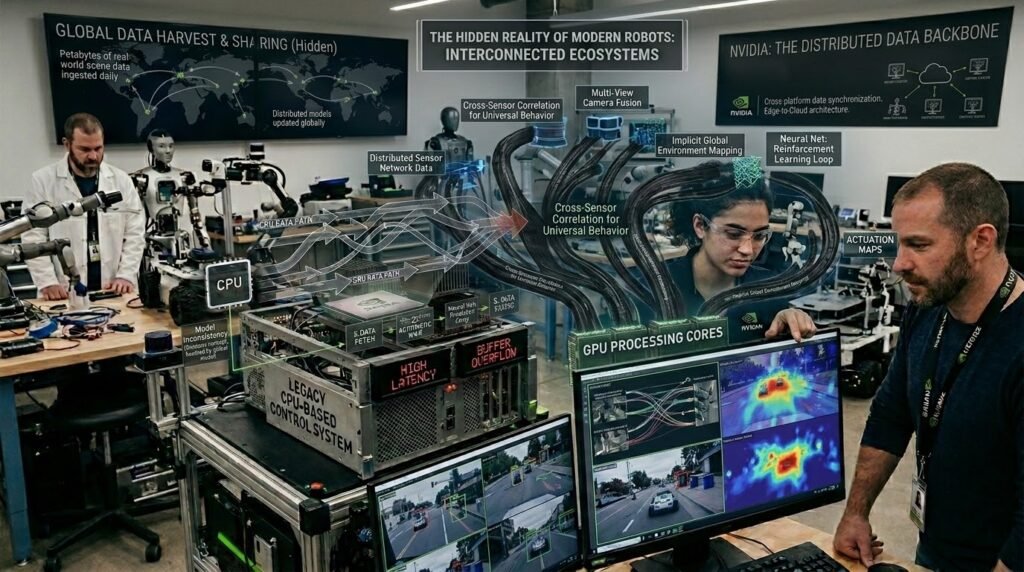
Traditional CPUs Could Never Handle Modern Robotics
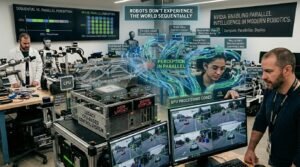
Traditional CPUs are excellent for sequential tasks. But robots don’t experience the world sequentially — they experience it all at once. A humanoid robot walking through a warehouse must simultaneously:
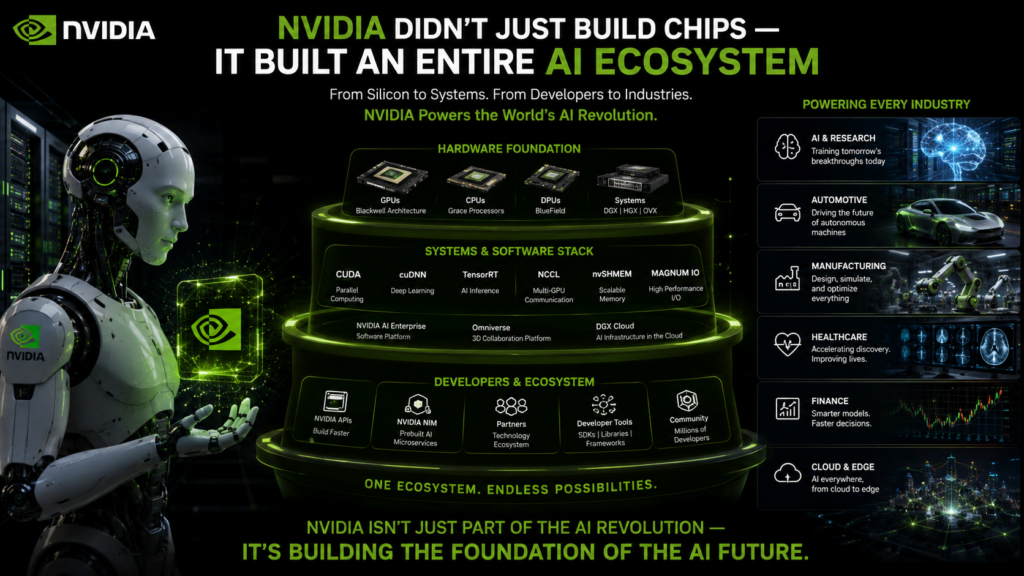
NVIDIA Didn’t Just Build Chips — It Built an Entire AI Ecosystem
The deeper advantage isn’t hardware — it’s the ecosystem. Similar to what Microsoft did with Windows or Apple with iPhone, once developers integrate deeply, switching becomes almost impossible.
Foundation platform accelerating every part of robot development
Optimizes deep learning models for real-time edge deployment
Train thousands of robots in photorealistic virtual environments
Digital twin platform for physically accurate sim-to-real transfer
Infrastructure-as-a-service for massive AI model training
Compact, power-efficient AI for on-device robot inference
“One Ecosystem. Endless Possibilities. NVIDIA isn’t just part of the AI revolution — it’s building the foundation of the AI future.“
The Economics of Simulation vs Reality
Training robots in the real world is brutally expensive. A humanoid robot falling repeatedly damages components, slows development, and burns capital. Simulation changes the economics entirely — train thousands virtually, deploy one physically.
$100K–$500K+
$50K–$150K+
$20K–$100K+
$10K–$50K+
Slow
Risky
Fast
Scalable
Smart teams use simulation to scale real-world intelligence. If the sim-to-real pipeline becomes reliable, robotics development will accelerate exponentially — and NVIDIA sits at the center.
Why Humanoid Robots Depend on NVIDIA More Than Most People Realize
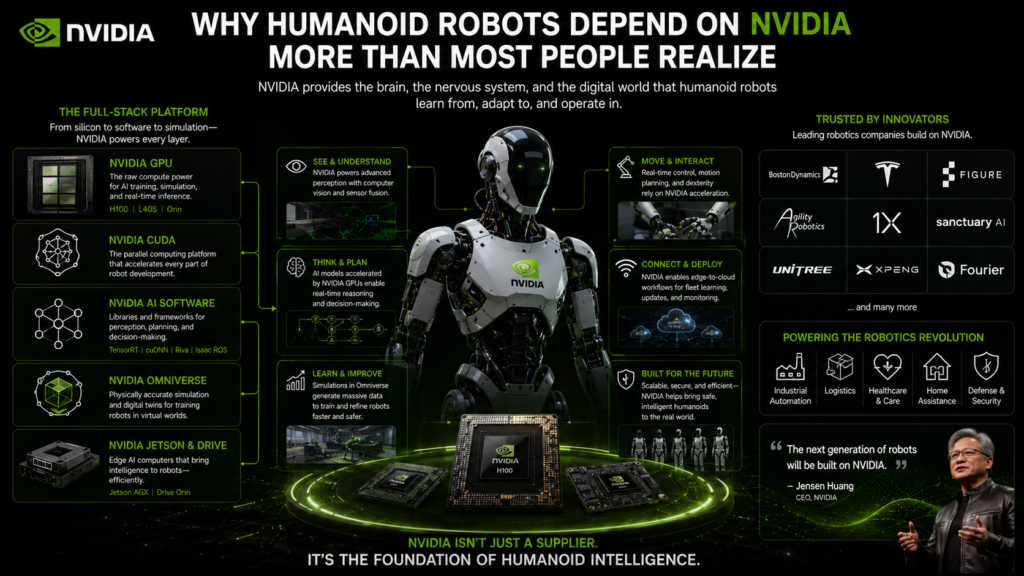
A self-driving car navigates roads. A humanoid robot attempts to navigate the human world itself — stairs, doors, tools, furniture, crowds, balance, hand coordination, object manipulation, human communication. The computational demand is almost insane.
Raw compute power for AI training, simulation, and real-time inference · H100 / L40S / Orin
The parallel computing platform that accelerates every part of robot development
TensorRT · cuDNN · NCCL · Libraries for perception, planning, and decision-making
Physically accurate simulation and digital twins for training robots faster and safer
Edge AI computers that bring living intelligence to robots efficiently · Jetson AGX · Drive Orin
Tesla AI
Figure AI
Sanctuary AI
Agility Robotics
1X Technologies
Unitree
Fourier
“The next generation of robots will be built on NVIDIA.” — Jensen Huang, CEO NVIDIA
The AI Arms Race Is Also a Chip War
The public focuses on AI models. But underneath those systems lies an industrial-scale computing race. Robotics intensifies it — physical AI requires real-time on-device inference. Latency becomes dangerous. Robots need local intelligence.
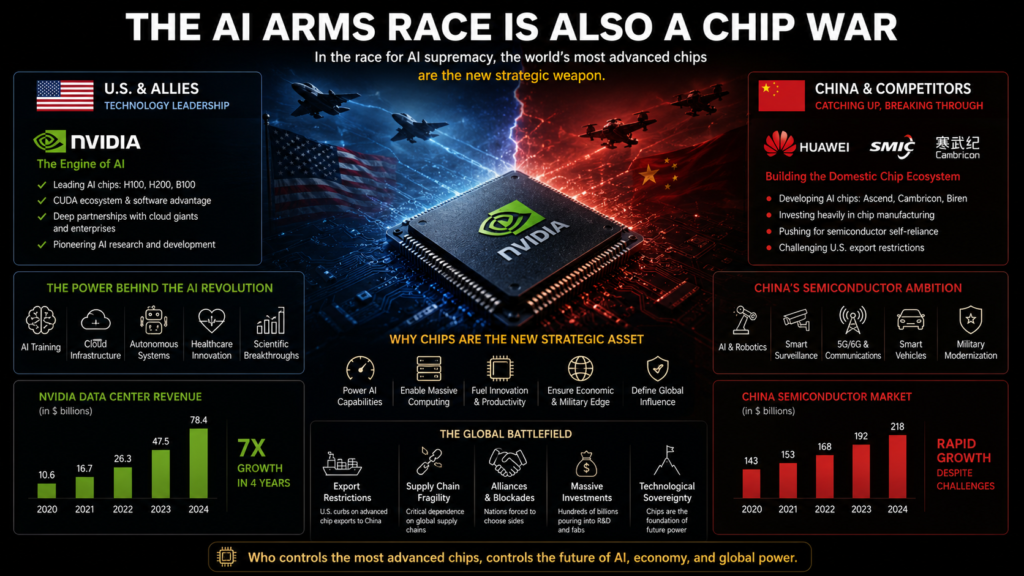
H100/H200/B100 · CUDA ecosystem · Full-stack platform · 7× data center growth in 4 years
MI300X targets data center · Open ROCm ecosystem · Strong CPU+GPU (EPYC+Instinct)
Gaudi AI accelerators · IFS manufacturing edge · Betting on Intel 18A and beyond roadmap
Huawei Ascend · Cambricon · SMIC · Massive state investment despite US export restrictions
“Who controls the most advanced chips controls the future of AI, economy, and global power. The chip war is no longer about one company — it is about who will power the AI era.”
What Most People Still Don’t Understand About Robotics
The robotics revolution is not really about robots. It is about physical intelligence — and the progression follows a clear pattern.
Every industrial revolution creates dominant infrastructure companies — railroads, electricity, oil, semiconductors, cloud computing. Now possibly: AI infrastructure.
NVIDIA positioned itself directly in the center of that transition at precisely the right moment.
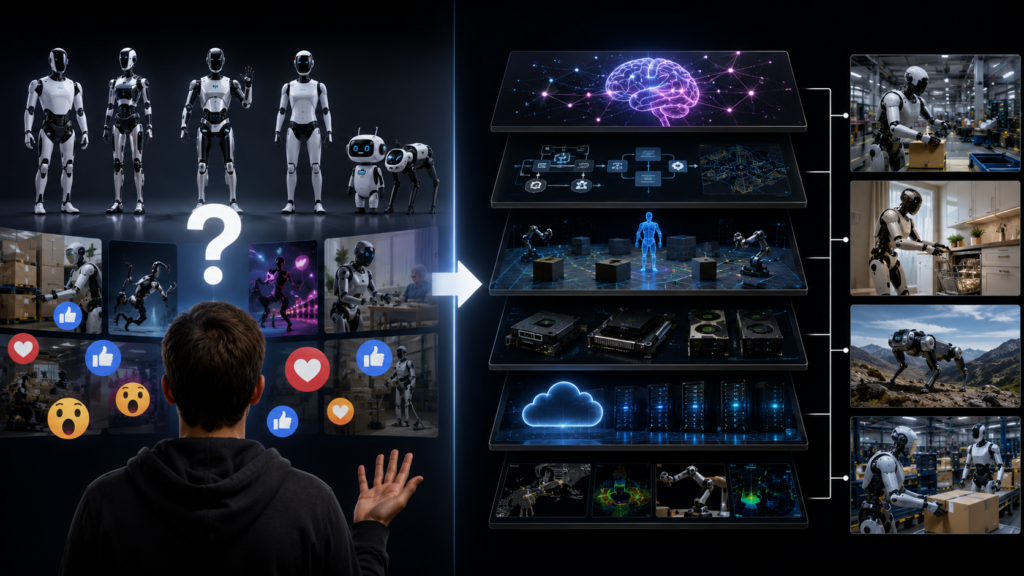
So What Should We Really Watch?
Not just robot demos. Watch the signals that truly matter over the next 5 years:
Quarterly orders predict robotics scale before it becomes publicly visible.
Data center expansion, cooling, energy investments as leading indicators.
How reliable sim-to-real transfer becomes — the most critical bottleneck.
How many companies standardize on NVIDIA infrastructure end-to-end.
Export controls, SMIC progress, AMD and Intel competitive moves.
When language models, vision, and physical control merge into intelligent agents.
Robotics adoption may not happen all at once — industry by industry, workflow by workflow, warehouse by warehouse. And one day people may suddenly realize that NVIDIA didn’t merely participate. It became the foundation underneath it all.
The Company That Once Powered Video Games
May Ultimately Power the
Physical AI Economy
And honestly, that may be one of the wildest technology stories of our generation.
Robotics
AI Infrastructure
Physical AI