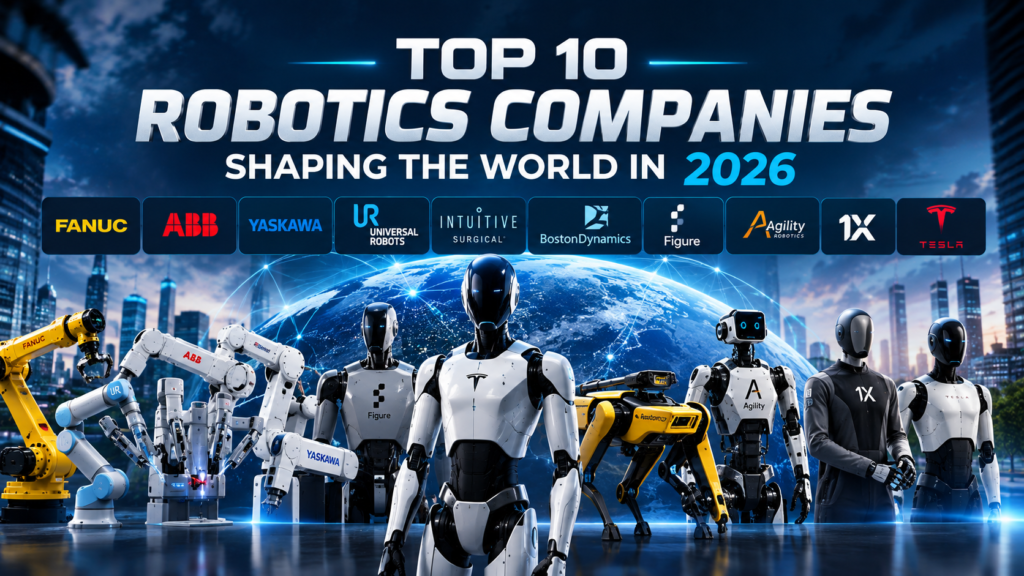
The robotics industry entering 2026: scale is becoming the real test
Robotics is no longer a single market. It is an ecosystem of industrial automation, collaborative robots, warehouse machines, surgical systems, quadrupeds, humanoids, consumer robots and the software and AI infrastructure that connects them.
The latest global baseline from the International Federation of Robotics (IFR) shows how large the installed industrial-robot economy already is. In 2024, manufacturers installed 542,000 industrial robots worldwide, the fourth consecutive year above 500,000 annual installations. Asia accounted for 74% of new installations, while China alone represented 54% of global deployments and exceeded two million robots in operational stock. IFR also recorded about 16,700 medical robots sold in 2024 and nearly 20 million consumer service robots sold, with domestic floor-cleaning and lawn-care robots forming the largest consumer category.
That matters because the next phase of robotics is not simply about building a robot that can walk, weld or pick an object. The competitive question is becoming much harder: Can a company manufacture the machine reliably, put it into real environments, collect operational data, satisfy safety requirements, win paying customers and scale the economics?
For 2026, the IFR outlook cited in KUKA’s 2025 annual report points to roughly 619,000 industrial-robot installations globally, with Asia remaining the dominant market. This is a forecast, not a final 2026 result, so it should not be presented as an actual year-end number until IFR publishes the corresponding dataset.
The 10 companies at a glance
1M+ industrial robots shipped
500K+ robots shipped/installed
540K robots installed
100K+ cobots sold
11,710 da Vinci systems installed
Atlas + Spot + Stretch ecosystem
$1B+ committed Series C
$300M+ multi-year Digit orders
10K NEO first-year capacity booked
Optimus mass-production plan
FANUC — The installed-base giant of industrial robotics
FANUC is one of the clearest examples of robotics leadership measured by physical scale rather than headlines. The company reached the milestone of 1 million cumulative industrial robots shipped in August 2023, after 46 years of robot production. FANUC’s 2025 integrated report continues to identify the one-million-robot milestone as a defining part of its history.
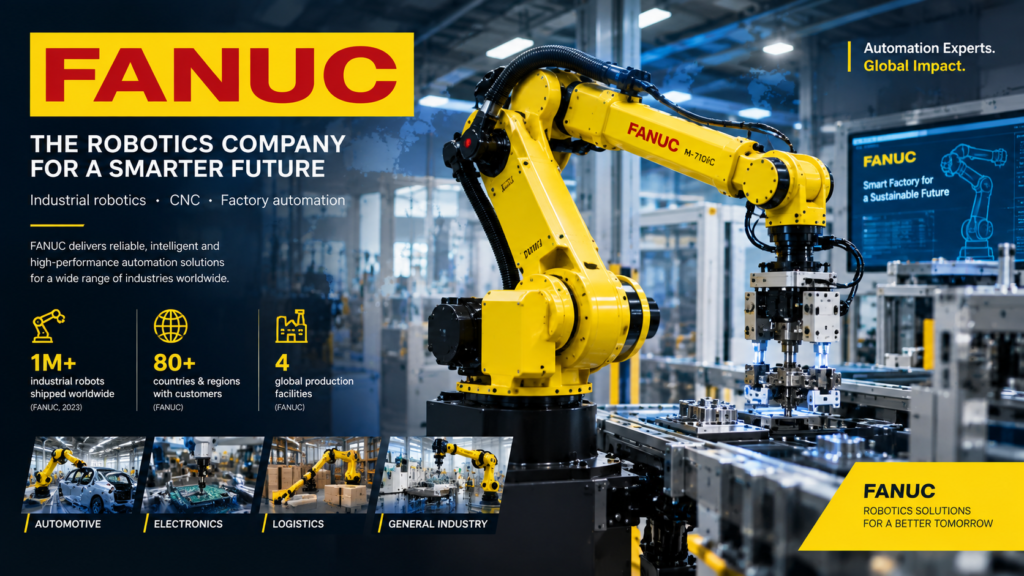
The significance of that number is not that every robot is the latest form of AI. It is that FANUC has decades of manufacturing, motion-control, service, reliability and application knowledge embedded in a huge installed base. That creates a different kind of competitive advantage: customers are not merely buying a robot arm; they are buying into an industrial ecosystem that includes controllers, servo technology, simulation, vision, maintenance and application support.
FANUC is also moving into the Physical AI conversation rather than remaining a purely traditional automation supplier. In 2026 it announced initiatives involving AI welding, Google AI agents and collaboration with NVIDIA, while also planning a new U.S. factory and distribution investment intended to strengthen robot manufacturing capacity.
Primary sources: FANUC 1-million-robot announcement · FANUC Integrated Report 2025 · FANUC 2026 news releases
ABB Robotics — Half a million robots and a global service machine
ABB Robotics brings a different form of scale. ABB states that its robotics business has shipped more than 500,000 robot solutions and operates across 53 countries and more than 100 locations. ABB also describes an installed base of more than 500,000 robots supported by a broad global service network.
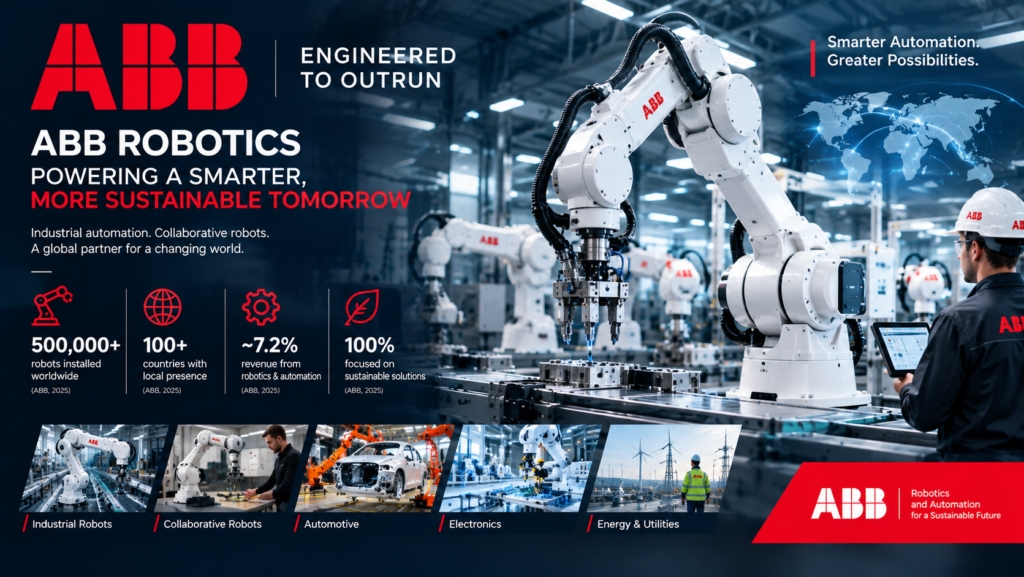
That service footprint matters because industrial robotics is not a consumer gadget business. A factory robot can remain economically useful for many years, and the value of maintenance, spare parts, software, simulation and process engineering can be as important as the mechanical arm itself.
ABB’s 2025 financial reporting also shows that its robotics business extends beyond conventional robot arms into autonomous mobile robots, application cells, smart systems, digital services and software. In automotive manufacturing, ABB reports more than 500,000 robots installed worldwide and cites applications ranging from body-in-white automation to EV battery production and logistics.
Primary sources: ABB Robotics 2026 brochure · ABB Robotics automotive data · ABB Financial Report 2025
Yaskawa — A robotics powerhouse built on motion control
Yaskawa is easy to underestimate if robotics is viewed only through humanoids. The company’s industrial footprint is enormous. Yaskawa’s current corporate data lists approximately 540,000 robots installed and about 43,000 robots annually, alongside 15,000 employees worldwide. For fiscal 2026, Yaskawa reported consolidated revenue of ¥542.1 billion.
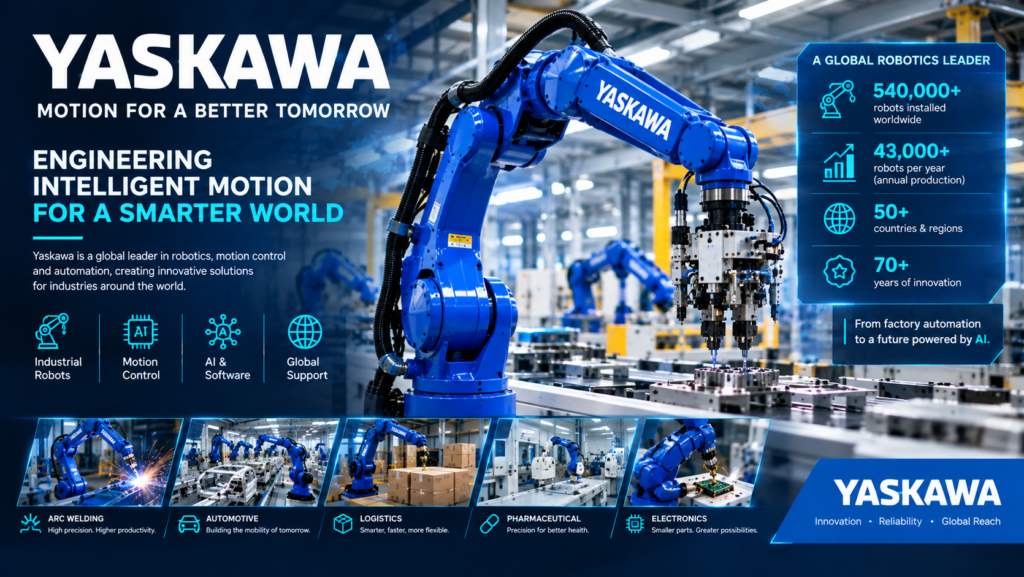
The company’s strength comes from controlling more of the motion stack. Yaskawa operates across servo drives, motors, controllers and robotics, meaning the robot is part of a broader industrial-control architecture rather than an isolated machine.
In 2026 Yaskawa continued expanding its collaborative-robot portfolio, including the MOTOMAN-HC35 and HC12, while its broader strategy is increasingly connected to AI, industrial software and intelligent automation. This makes Yaskawa particularly important to the transition from conventional automation toward more adaptive Physical AI.
Primary sources: Yaskawa corporate facts · Yaskawa 2026 corporate data · Yaskawa investor relations
Universal Robots — The commercialization benchmark for cobots
Universal Robots represents one of the most important shifts in factory automation: making industrial robots accessible to companies that do not have the resources or appetite for a conventional robot cell.
The company states that it has sold more than 100,000 collaborative robots used in production environments around the world. Its UR+ ecosystem contains more than 400 certified kits, components, grippers, software and safety accessories, reinforcing the idea that the product is an automation platform rather than simply a robot arm.
September 2026 is especially important for the company because Universal Robots unveiled its Gen 7 platform, positioned as AI-ready and designed for physical-AI deployment in industrial operations. That is a useful marker for where the cobot industry is heading: the next competitive layer is not merely payload and reach, but software, connectivity, perception and easier deployment.
Primary sources: Universal Robots company and installed-base data · Universal Robots 2026 news
Intuitive Surgical — The installed-base leader in robotic surgery
Medical robotics is often left out of conversations dominated by humanoids, yet it is one of the clearest examples of robotics becoming a large-scale clinical business. Intuitive Surgical’s da Vinci system had an installed base of 11,710 systems as of June 30, 2026. In the second quarter of 2026 alone, Intuitive placed 468 da Vinci systems, including 246 da Vinci 5 systems.
The company’s Q2 2026 revenue was $2.89 billion, up 19% year over year, while combined da Vinci and Ion procedures grew approximately 16%. Intuitive ended the quarter with $8.63 billion in cash, cash equivalents and investments.
This is a fundamentally different robotics business model from selling a humanoid. The installed robot creates a long-term ecosystem of procedures, instruments, accessories, software, training and hospital relationships. That recurring clinical workflow is a major reason Intuitive belongs in any serious global robotics landscape.
Primary source: Intuitive Surgical Q2 2026 results
Boston Dynamics — Advanced mobility moving toward industrial scale
Boston Dynamics is important because it has spent decades solving a problem that remains extremely difficult: making robots move reliably through environments designed for humans.
Its commercial portfolio spans Spot, the quadruped platform used for inspection and safety work, Stretch, a warehouse robot, and Atlas, its electric humanoid platform. Hyundai reported in January 2026 that Spot was operating in more than 40 countries and that Stretch had unloaded more than 20 million boxes globally since its 2023 launch.
Atlas is now entering a different phase. Boston Dynamics announced in January 2026 that product-version Atlas manufacturing would begin immediately and that its 2026 deployments with Hyundai and Google DeepMind were already fully committed. Hyundai’s wider robotics strategy targets a scalable production system capable of 30,000 robot units annually by 2028, with Atlas planned for deployment at Hyundai’s Georgia manufacturing facility beginning in 2028.
There is an important caveat: Boston Dynamics has not yet demonstrated Atlas at mass-production scale. Reuters reported in September 2026 that the company remained unprofitable and had not yet deployed Atlas at scale. That does not weaken the engineering significance; it simply means Atlas should be described as an advanced platform entering commercialization, not as an already mass-deployed humanoid.
Primary sources: Boston Dynamics Atlas 2026 · Hyundai AI Robotics Strategy 2026 · Reuters, September 2026
Figure AI — Capital, AI models and manufacturing scale converge
Figure represents the new generation of robotics companies built around AI from the beginning. In September 2025, Figure announced more than $1 billion in committed Series C capital at a $39 billion post-money valuation. Investors included NVIDIA, Intel Capital, Qualcomm Ventures, LG Technology Ventures, Salesforce and others.
The important development in 2026 is that Figure is not treating funding as the endpoint. Its BotQ manufacturing facility has moved from prototype production toward a high-output operation. In April 2026, Figure reported that it had delivered more than 350 Figure 03 humanoids and demonstrated a production rate of one robot per hour, a 24-fold throughput improvement in under 120 days.
Figure also reported more than 9,000 actuators produced across multiple SKUs, a battery-line first-pass yield of 99.3%, more than 50 in-process inspection points and more than 80 functional verification tests for each robot before sign-off.
Those manufacturing metrics are unusually important in humanoid robotics. A robot that works in a laboratory is not yet an industry. The ability to manufacture, test, service, update and operate hundreds or thousands of physical machines is a completely different engineering challenge.
Primary sources: Figure Series C · Figure 03 production update, April 2026 · Reuters coverage of Figure financing
Agility Robotics — The commercial-order and real-world deployment signal
Agility Robotics deserves attention because its story is less about a spectacular prototype and more about putting a humanoid into real industrial workflows.
As of May 2026, Agility disclosed more than $300 million in multi-year customer orders for Digit v5, subject to contractual milestones. Its SEC-filed investor materials specify that this figure relates to approximately 1,000 Digit v5 robots under three-year robot-as-a-service contracts. The figure is potential multi-year contract value, not current-period revenue.
By September 2026, Agility reported more than 65,000 operational hours across commercial deployments. Digit 4 has worked with customers including GXO, Schaeffler, Amazon and Toyota Motor Manufacturing Canada. At GXO’s Flowery Branch facility, Agility reported a cumulative milestone of 100,000 totes handled at approximately 98% accuracy while on-task.
Agility’s September 2026 Digit 5 launch is particularly significant because the company is targeting cooperative safety — allowing a humanoid to work near people without the physical safety barriers traditionally used around industrial automation. The company expects early access in 2027, with broader general availability later in 2027.
Primary sources: Agility Digit 5, September 2026 · Agility SEC investor presentation · Agility financing/listing announcement
1X — Turning the humanoid from factory equipment into a home product
1X is pursuing one of the hardest robotics markets of all: the home. Industrial robots operate in controlled environments. A home robot has to deal with stairs, furniture, pets, children, changing lighting, unpredictable objects and the enormous diversity of human routines.
1X reported that when NEO launched its preorder campaign, it booked out its entire first-year production capacity — more than 10,000 NEOs — in five days. In April 2026, the company said its Hayward NEO Factory had commenced full-scale production and had capacity for up to 10,000 NEOs per year, with plans to reach 100,000+ units annually by the end of 2027.
1X is also unusually vertically integrated for a young humanoid company. It says it designs and manufactures critical components in-house, including motors, batteries, structures, transmission systems and sensors. The company reported more than 200 employees at the Hayward facility and 17,000 motors manufactured since production began there.
NEO also uses NVIDIA Jetson Thor onboard computing and 1X’s Redwood AI model. The company is explicitly building the product around learning in homes, with an Expert Mode that allows scheduled remote supervision for tasks the robot does not yet know.
Primary sources: 1X NEO Factory · 1X NEO order information
Tesla — The mass-production bet on humanoid robotics
Tesla belongs on this list for a reason that is fundamentally different from FANUC, Intuitive Surgical or Agility Robotics. Tesla has not demonstrated a million humanoid robots in operation. It has not demonstrated mass commercial deployment of Optimus. What Tesla has demonstrated is something potentially just as consequential: an attempt to connect advanced AI, enormous manufacturing infrastructure and humanoid robotics into one vertically integrated production strategy.
Tesla’s January 2026 shareholder materials state that Optimus Gen 3 is the company’s first design intended for mass production. Preparations for its first production line were underway, with start of production planned before the end of 2026 and an eventual planned capacity of 1 million robots per year. Tesla’s disclosed robotics capacity table lists the California Optimus site as under construction rather than production.
That last point is essential. The one-million-unit figure is a planned capacity, not current annual output. It should not be quoted as “Tesla will produce one million Optimus robots in 2026.” The correct interpretation is that Tesla is designing a manufacturing system intended to reach that scale.
Tesla’s strategic advantage comes from the company’s existing experience in high-volume manufacturing, batteries, motors, power electronics, embedded computing and AI. Tesla also has a large real-world vehicle fleet generating data for its broader AI systems. Whether that advantage transfers efficiently to humanoid robotics remains an open engineering and commercial question, but the industrial foundation makes Tesla one of the companies that could materially change the economics of humanoid production if the plan succeeds.
Primary source: Tesla January 2026 financial/shareholder materials
What these 10 companies reveal about the robotics race
Looking at the companies together reveals a much more interesting picture than a simple humanoid-versus-industrial-robot debate.
FANUC, ABB and Yaskawa demonstrate that the real robotics economy is already enormous. Their advantage is measured in installed fleets, factories, service networks, motion control and decades of reliability.
Universal Robots shows how a robot category can expand by reducing deployment complexity. Cobots made automation accessible to smaller production environments, and the next step is making those machines more AI-aware.
Intuitive Surgical demonstrates that robotics can become a recurring clinical platform rather than a one-time hardware sale. Its installed base and procedure volume are a reminder that robotics has already reached deep commercial maturity in specific verticals.
Boston Dynamics represents the transition from extraordinary mobility research to industrial deployment. Figure represents the attempt to build a general-purpose humanoid around AI and scalable manufacturing. Agility demonstrates the importance of actual customer operations and contracted demand. 1X is testing whether humanoids can cross from factories into ordinary homes.
And Tesla represents the most aggressive manufacturing thesis: if humanoid robotics becomes a high-volume product, the winner may not simply be the company with the best robot demo. It may be the company capable of manufacturing, powering, updating, servicing and economically deploying millions of machines.
A more useful way to measure robotics leadership in 2026
How many machines are actually deployed?
How much real-world work has the robot completed?
Are customers actually committing capital?
Can the company repeatedly manufacture the robot?
Can the robot perceive, reason, learn and adapt?
Can the company fund the long manufacturing and R&D cycle?
Can robots operate reliably around people?
Does the robot create enough value to justify deployment?
The biggest misconception about the 2026 robotics race
The biggest mistake is to assume that the company with the most impressive humanoid demonstration automatically has the strongest robotics business.
Robotics is brutally capital intensive. Mechanical design, actuators, batteries, sensors, motors, electronics, manufacturing, software, simulation, data collection, safety certification, field service and customer integration all have to work together.
A useful robot that cannot be manufactured is a prototype. A manufactured robot that cannot operate safely is a liability. A safe robot that nobody pays for is a research project. And a robot that customers buy but that costs more to operate than the value it creates is not yet a scalable business.
The companies shaping 2026 are therefore competing on several layers simultaneously: hardware, AI, manufacturing, capital, data, safety, distribution and economics. That is why the established industrial leaders and the new humanoid companies can both belong in the same conversation — they are attacking different parts of the same long-term robotics transition.
Global market context: robotics is already bigger than humanoids
Humanoid robots dominate headlines in 2026, but the global robotics economy remains much broader. IFR’s latest published World Robotics data recorded 542,000 industrial robot installations in 2024, more than double the level of ten years earlier. Asia represented 74% of new industrial deployments, and China alone accounted for 54% of global installations.
IFR also reported strong growth in medical robotics and close to 20 million consumer service robots sold in 2024. This means that the near-term robotics market is not waiting for humanoids to mature. Factories, hospitals, warehouses and households are already buying specialized robots at scale.
The humanoid race is therefore best understood as a potential new layer on top of an existing robotics economy. If humanoids become economically viable across many tasks, they could expand the addressable market dramatically because a single general-purpose machine could potentially work across environments that currently require multiple specialized automation systems.
Primary source: International Federation of Robotics — World Robotics 2025
Conclusion: the next robotics era will be won on the factory floor
The robotics industry has reached a point where demonstrations are no longer enough. The difficult part is scaling intelligence into reliable physical systems.
FANUC, ABB and Yaskawa prove that industrial robotics can operate at extraordinary scale. Universal Robots proves that easier deployment can expand the customer base. Intuitive Surgical proves that specialized robotics can become a multibillion-dollar clinical platform. Boston Dynamics demonstrates how advanced mobility can move toward industrial use.
Meanwhile, Figure, Agility, 1X and Tesla are testing different answers to the humanoid question. Figure is combining AI, capital and manufacturing throughput. Agility is emphasizing commercial deployment and customer orders. 1X is pushing toward the home. Tesla is attempting to make humanoid robotics a mass-manufacturing problem.
The most important question for the next few years is therefore not simply “Which robot is smartest?”
It is:
That is the question that will determine which of today’s robotics leaders become the industrial giants of the next decade.
Research notes & source methodology
This article uses company filings, official company announcements and the International Federation of Robotics as primary evidence wherever possible. Reuters is used selectively for independent reporting and for developments where company claims require external context.
- “Installed” and “shipped” are not treated as identical unless the source itself uses those terms.
- Orders and reservations are not treated as revenue.
- Planned production capacity is not treated as current production.
- Funding valuation is not treated as cash on the balance sheet.
- Company-reported performance metrics are attributed to the company rather than presented as independently audited facts.
- 2026 forecasts are clearly labeled as forecasts until final-year industry data becomes available.
- NIST — Humanoid Robot Baseline Performance Benchmark.
- NIST — ManipulationNet robot-performance testing.
- Fraunhofer IPA — independent humanoid benchmark using Unitree G1.
- McKinsey — physical AI and potential $1T economic value by 2040.
- Goldman Sachs — $38B humanoid market forecast for 2035.
- MarketsandMarkets — 2026–2035 humanoid market forecast.
- Roland Berger — humanoid robotics revenue scenarios.
- Counterpoint Research — 2026 humanoid shipments.
- Tesla — 2026 Optimus manufacturing plans.
- Figure — Figure 02 BMW deployment and Figure 03.
- Boston Dynamics — current Atlas specifications and 2026 deployment plans.
- Agility Robotics / SEC — Digit commercial deployments and v5 economics.
- Unitree — G1 price and capabilities.
- Apptronik — Apollo and Apollo 2 / Robot Park.
- UBTECH — Walker S2 specifications and autonomous battery swapping.
- XPENG — IRON production line, 76 DoF and 2,250 TOPS.
- Qualcomm — heterogeneous fleets of humanoids, AMRs and drones.
- MIT Technology Review — https://www.technologyreview.com
- IEEE Spectrum — https://spectrum.ieee.org
- McKinsey & Company — https://www.mckinsey.com
- Stanford AI Lab — https://ai.stanford.edu
- Harvard Business Review — https://hbr.org
- NVIDIA Blog — https://blogs.nvidia.com
- International Federation of Robotics — https://ifr.org
- World Economic Forum — https://www.weforum.org
Last updated: September 17, 2026.