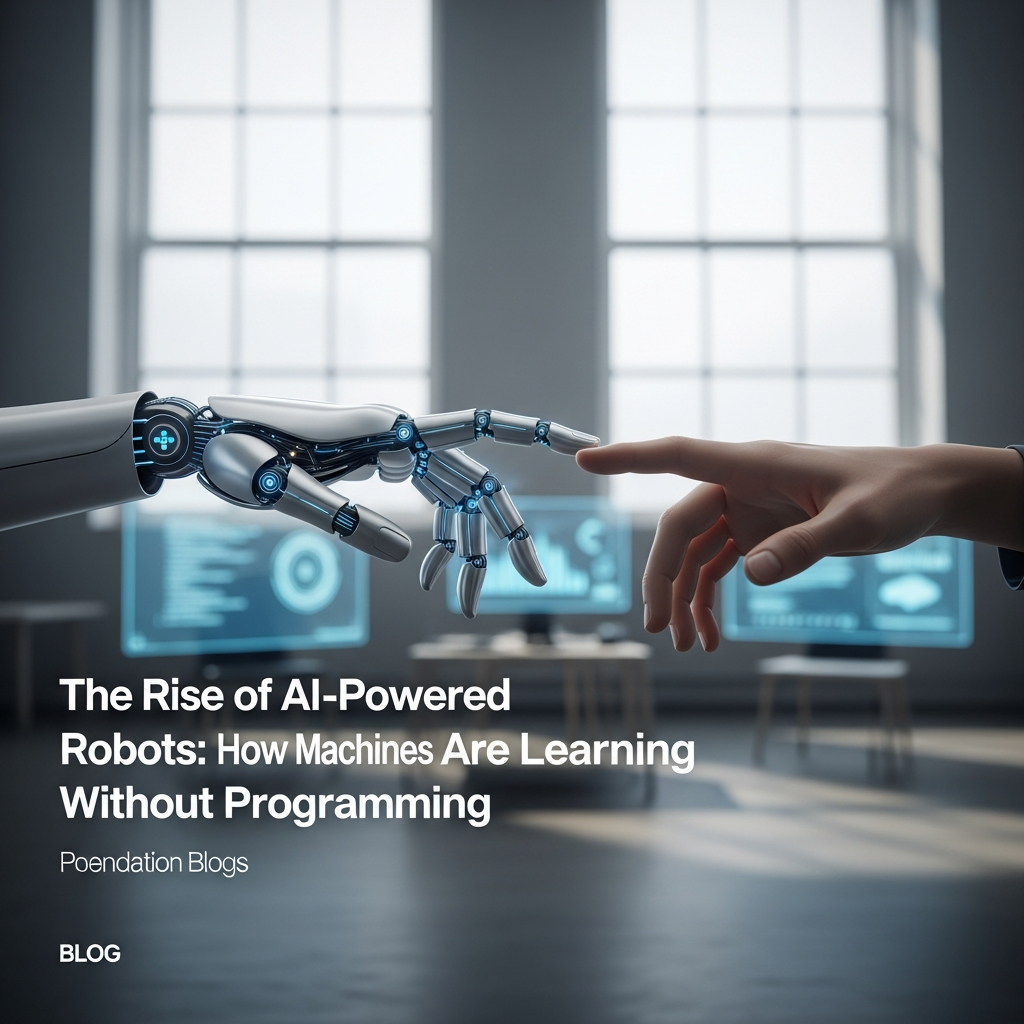
The air in the room crackles with anticipation. A sleek robot, like something straight out of a science fiction movie, meticulously organizes items across the lab table. It moves gracefully, and one might even say thoughtfully. What’s truly remarkable is that this shiny piece of hardware didn’t come pre-installed with lines of precise programming dictating its every move. Instead, it has learned by observing, by trial and error, much like a human toddler stacking blocks in a playpen, occasionally toppling them over before achieving that elusive perfect balance.

This isn’t just a scene from a futuristic drama; it’s the heart of what’s happening right now as AI-powered robots rise to prominence, learning without traditional programming. But how are these machines gaining such autonomy? And what ripple effects are being felt across industries? It’s a tech-driven narrative that’s as fascinating as it is impactful.
Beyond the Code: How Machines Learn
In traditional computing, programmers meticulously script every action a machine undertakes. Code a mistake, and you’ve got a problem. But inspired by the neural networks found in our own brains, AI-powered robots are beginning to learn from experiences—thanks to tech revolutionaries like Google’s DeepMind and Tesla’s AI endeavors.
At the core of learning without programming is reinforcement learning. It’s a concept that sounds deceptively simple: allow a machine to interact with an environment, make mistakes, receive feedback, and adjust. Picture an AI robot stumbling around a virtual room, learning the best way to reach a door latch not because it’s been told precisely how, but because it’s learned what doesn’t work. This trial-and-error method closely mimics how children learn to navigate their world, and it’s the backbone of many AI initiatives today.
Deep learning plays a pivotal role here too, particularly convolutional neural networks (CNNs), which process vast sums of data to identify patterns or features. It’s as if each robot comes equipped with powerful digital eyesight, processing visuals from its environment, much like how we use our eyes and brains to interpret and react to stimuli.

AI in the Wild: Real-World Applications
Many industries are experiencing what feels like an influx of wild robot sightings as these learning machines integrate more deeply into societal frameworks. From homes to factories, and operating rooms to farms, AI-powered robots are becoming indispensable partners.
In homes, these robots are no longer just cleaning tools. Firms like iRobot are developing smart vacuum cleaners equipped with learning capabilities that not only map out rooms but continuously adapt to changing furniture and floor layouts. Some are even beginning to anticipate human behavior, suggesting a future where your morning routine includes a digital assistant brewing coffee without being asked.
Industrial applications reveal perhaps the most dramatic impact. Tech behemoths like Boston Dynamics have developed robots that handle complex logistics tasks in warehouses more efficiently than ever. These robots aren’t just replicating human actions; they are optimizing processes by learning from operational data, improving safety standards, and reducing error margins. With companies like Amazon injecting vast resources into AI research, shouldn’t we prepare for a revolution in how goods are manufactured and delivered?
One of the most stirring advancements is in healthcare, where robots are supporting doctors with tasks too precise or too dangerous for human hands alone. Consider the surgical robots assisting in microsurgery, learning to distinguish healthy cells from diseased ones through AI-enhanced vision systems. This level of finesse, driven by AI, expands a doctor’s reach into procedures once thought too complex.
The Digital Brain: AI Models and Algorithms
AI models are the brains behind the beauty. They encompass algorithms capable of learning from and adapting to real-world data. Think of them as sophisticated chefs fine-tuning recipes—that is, the AI’s decision-making processes—by constantly tasting and adjusting.
Leading this culinary tech revolution is NVIDIA, a name as synonymous with graphical processing as it is with AI innovation. Their chipsets have become the backbone for training AI models, providing the speed needed to compute vast data sets, facilitating real-time decision-making capabilities.

Robots don’t just learn like humans; they sense their world too. Equipped with advanced LIDAR, ultrasonic sensors, and haptic systems, they interact with their environment in rich, data-driven ways. Picture how Tesla’s autonomous vehicles navigate, equipped with a suite of sensors that create a dynamic 3D map of their surroundings. It’s the same principle at play across different sectors—robots drawing on a tapestry of sensor-generated data for seamless functionality.
As if conjured from a crystal ball, the International Federation of Robotics recently revealed that the global robotics market is expected to skyrocket, reaching an unprecedented valuation by 2030. Investments are pouring in from venture capitalists eager to stake a claim on what may well be the ‘gold rush’ of our era.
Economic Reformation: Jobs and Industry Shifts
Of course, with such growth comes seismic shifts in the job market. While fears typically align with job displacement, the reality indicates a transformation rather than a termination. New roles are emerging—roles that require human oversight of AI systems, leading to increased demand for specialists who can bridge the gap between robotics and application in human contexts.
However, as any good economics lesson will tell us, there are costs. Developing and deploying these AI-infused robots in real-world scenarios involves high initial investments and an ongoing commitment to fostering adaptive AI this way. The AI landscape isn’t for the faint-hearted but for the visionary willing to place bets on a digitally woven future.
Yet, for all the success stories, not every nut and bolt in this grand machine fits perfectly. The technological, ethical, and logistical challenges are numerous, serving as a sobering reminder that we are venturing into uncharted territory.
There’s the elephant in the room—current AI models can still falter. Biases in data lead to skewed learning, creating robots that make incorrect assumptions. It’s a reminder from the trenches of tech development that clean, unbiased data is king. Meanwhile, the computational heft required to simulate real-time learning can bottleneck progress, demanding ever-greater efficiencies from AI frameworks.
Ethics in Question: The Moral Maze
And what of ethics? As machines become more autonomous, we’re nudged ever closer to the line that separates caution from recklessness. Machines making decisions in life-and-death scenarios—be it in autonomous driving or surgical procedures—will force us into unprecedented legal and ethical territory. Who do we hold accountable when things go south?
Public sentiment isn’t quite as predictable as a binary code. The integration of AI-powered robots into daily life evokes a range of emotions—from excitement to skepticism. Building public trust, through transparent policy-making and demonstrated benefits, remains a key hurdle in this burgeoning field.
Looking ahead, ask any futurist and they’ll tell you, with a hint of jest, that predictions about AI are a bit like forecasting the weather—sometimes you’re spot on, and other times you’re left holding an umbrella under clear skies.
Short-Term Developments: The Next 3–5 Years
Expect rapid advancements in AI algorithms to make robots even more autonomous. In manufacturing, expect robots that can swap between multiple complex tasks on the fly, reducing downtime and maximizing outputs. Healthcare could see AI making real-time decisions in concert with human inputs, dramatically improving outcomes.
In the long run, robots could become such an entwined part of our psyche that it begs the question—will we ever consider our daily lives separable from them? The vision is a world where robots are companions, collaborators, and even creators. When Thomas Huynh shared his thoughts, he humorously likened this evolution to having “an iPhone-backed assistant with legs in every home,” a notion that’s increasingly plausible.
But with such ubiquity comes the question of dependency. Will we lose certain skills in the process of adopting this widespread automation, and how will societies balance technological dependence with personal empowerment?
So what of those navigating these waters? Whether you’re a business leader, developer, or just a keen enthusiast of this intriguing rise, here’s what you might consider focusing on:
1. Collaboration Over Competition: Partner with tech ecosystems fostering AI collaborations. Open up to AI-as-a-service models that leverage cloud-based solutions for cost-effective scaling.
2. Skill Up and Cross-Train: Foster a workforce that’s not just tech-savvy but AI-fluent, able to manage the intricacies of this intertwined digital and physical landscape.
3. Ethics and Transparency: Maintain transparent business models that not only adhere to regulations but actively involve users in the evolution of AI technologies.
4. Investment in Infrastructure: Prioritize upgrading infrastructure for AI compatibility—be it data handling capabilities or seamless AI integration frameworks.
5. Users at the Core: Finally, maintain a user-centric approach. Take into account cultural implications, user behavior changes, and the ethical implications of deploying AI-powered systems.
What Should We Really Pay Attention To?
As we forge ahead into an era where machines learn, evolve, and adapt, one might wonder if this new wave of AI-powered robots will redefine the human experience altogether. Our capacity to wield this technology responsibly will set the tone for what lies ahead. In this tumultuous yet exhilarating exploration, it falls on us to balance our thirst for innovation with thoughtful discourse and ethical consideration. After all, we’re not just building robots; we’re shaping a future where humans and machines might work hand in circuit, with a harmony that truly feels natural.
Thomas Huynh – Admin of RoboZone.top
—
References & Further Reading:
– MIT Technology Review — www.technologyreview.com
– IEEE Spectrum — www.spectrum.ieee.org
– McKinsey & Company — www.mckinsey.com
– Stanford AI Lab — ai.stanford.edu
– Harvard Business Review — www.hbr.org
– NVIDIA Research / Blogs — www.nvidia.com/research
– International Federation of Robotics — www.ifr.org
– World Economic Forum — www.weforum.org