
Walk into a modern warehouse in 2026 and something feels different.
At first, you may not immediately notice it.
The conveyor belts are still moving. Pallets are still being loaded. Packages are still being sorted. Forklifts continue navigating narrow aisles. Workers in safety vests still walk across the facility carrying scanners and checking inventory.
Everything looks familiar.
Then you start paying closer attention.
A robot glides across the floor carrying a heavy container.
Another machine disappears into a storage aisle and returns with a specific product.
A robotic arm sorts packages at a speed no human could maintain for an entire shift.
In one corner, dozens of autonomous mobile robots move around each other with almost no collisions, continuously optimizing routes in real time.
And that’s when the realization hits.
The warehouse isn’t simply becoming automated.
It’s becoming intelligent.
For years, discussions about robots replacing jobs were dominated by fear, political debates, and sensational headlines. The reality unfolding inside warehouses today is far more nuanced and much more interesting.
Robots are not storming through warehouse doors and forcing humans out overnight.
Instead, they’re quietly absorbing specific tasks one workflow at a time.
And if current trends continue, warehouses may become the first large-scale environment where humans and AI-powered robots work side by side as part of the same operational ecosystem.

The Warehouse Labor Problem Nobody Can Ignore
One reason warehouse robotics is accelerating has nothing to do with technology.
It’s economics.
Across North America, Europe, Japan, South Korea, and increasingly China, warehouse operators face a growing labor challenge.
The rise of e-commerce fundamentally changed customer expectations.
Twenty years ago, waiting a week for delivery felt normal.
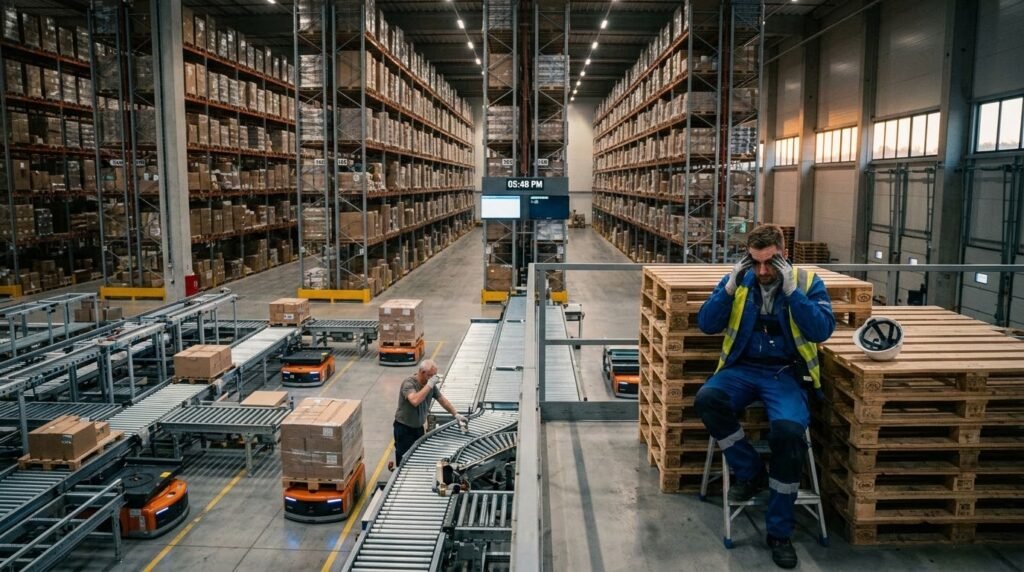
Today many consumers become impatient if a package doesn’t arrive the next day.
Some even expect same-day delivery.
That convenience creates enormous pressure on logistics networks.
Warehouses now operate closer to real-time fulfillment centers than traditional storage facilities.
The challenge is obvious.
Orders arrive continuously.
Inventory changes constantly.
Demand fluctuates unpredictably.
Labor shortages persist.
Meanwhile, consumers still expect faster delivery every year.
According to research from the World Economic Forum, labor shortages remain a significant concern across logistics and manufacturing sectors globally.
Warehouse operators aren’t pursuing automation because robots are exciting.
They’re pursuing automation because maintaining service levels is becoming increasingly difficult.
That distinction matters.
Technology adoption accelerates fastest when solving painful business problems.
And logistics currently has plenty of painful problems.
Amazon Changed Everyone’s Expectations
No discussion about warehouse robotics is complete without talking about Amazon.
Whether people admire Amazon or criticize it, one fact is impossible to dispute.

The company fundamentally reshaped global logistics.
When Amazon acquired Kiva Systems in 2012, many observers viewed the acquisition as simply another corporate purchase.
In hindsight, it may have been one of the most influential robotics acquisitions of the century.
Kiva’s technology eventually evolved into Amazon Robotics.
Rather than forcing humans to walk miles across massive warehouses retrieving products, autonomous robots could bring inventory shelves directly to workers.
That simple shift dramatically improved efficiency.
The concept sounds almost obvious today.
At the time, it was revolutionary.
The warehouse stopped being a static environment.
It became dynamic.
And once competitors saw the productivity gains, the robotics race began.
Why Walking Is Surprisingly Expensive
Most people imagine warehouse robots as humanoid machines.
The reality is much less cinematic.
And much more efficient.
Humans spend an enormous amount of time walking.
In large fulfillment centers, workers may cover ten to fifteen miles during a single shift.
From an engineering perspective, that’s incredibly wasteful.
Not because walking is bad.

Because movement consumes time.
Every second spent traveling between locations is a second not spent completing tasks.
Robotics companies realized something important.
Instead of making robots walk like humans, it was often more efficient to redesign workflows entirely.
Autonomous Mobile Robots (AMRs) emerged from this insight.
Unlike traditional industrial robots fixed in place, AMRs navigate independently through warehouses.
They transport products.
Move inventory.
Coordinate routes.
Avoid obstacles.
Adjust to changing conditions.
And increasingly, they do so with very little human intervention.

The AI Behind Modern Warehouse Robots Is Far More Advanced Than Most People Realize
Early warehouse automation relied heavily on predefined instructions.
Modern systems increasingly rely on artificial intelligence.
This distinction is critical.
Traditional automation follows rules.
AI adapts.
That difference becomes extremely important inside unpredictable environments.
A modern warehouse robot may need to process:
- visual data from cameras
- LiDAR sensor information
- inventory databases
- real-time traffic conditions
- worker movement patterns
- package recognition systems
- predictive demand forecasts
All simultaneously.
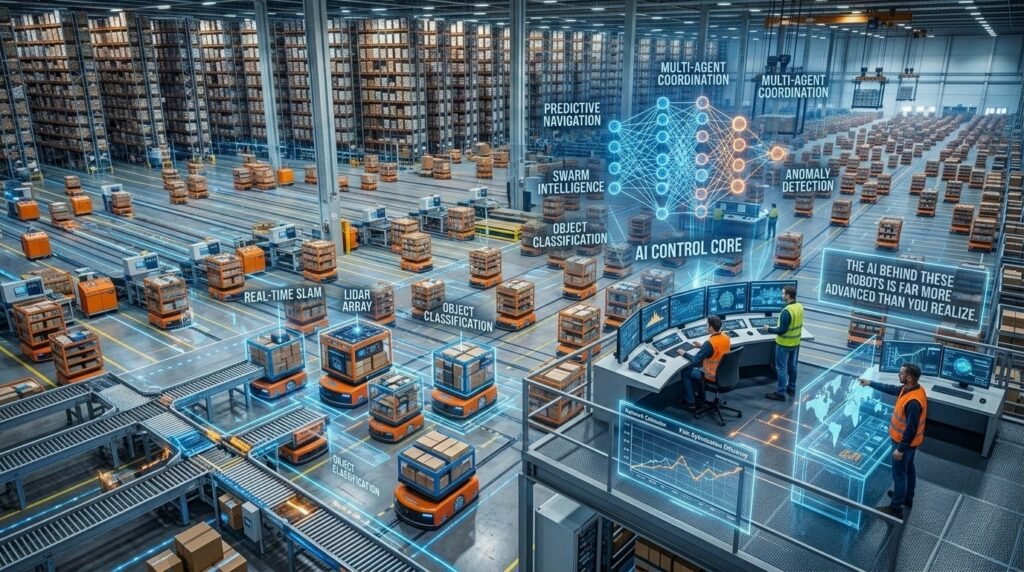
That’s why companies such as NVIDIA Robotics have become so influential.
Warehouse robotics increasingly depends on the same AI infrastructure driving breakthroughs in autonomous vehicles and humanoid robots.
The line separating logistics technology and artificial intelligence grows thinner every year.
The Rise of Digital Warehouses
One of the most fascinating developments happening right now is the emergence of digital twins.
A digital twin is essentially a virtual replica of a physical environment.
Imagine creating an exact digital copy of a warehouse.
Every shelf.
Every robot.
Every conveyor belt.
Every workstation.
Now imagine running simulations inside that virtual warehouse thousands of times before implementing changes in the real world.
That capability dramatically changes operational planning.

Companies can test:
- robot traffic flow
- inventory layouts
- staffing levels
- equipment placement
- expansion strategies
without disrupting actual operations.
Platforms such as NVIDIA Omniverse are helping accelerate this trend.
In many cases, warehouse managers can identify inefficiencies digitally before they become expensive real-world problems.
That level of optimization was almost impossible a decade ago.
Humanoid Robots Are Beginning to Enter the Conversation
Most warehouse robotics today still relies on specialized machines.
Autonomous carts.
Sorting robots.
Robotic arms.
Mobile inventory systems.
However, a new category is starting to attract enormous attention.

Humanoid robots. Companies including:
- Tesla
- Figure AI
- Agility Robotics
- Apptronik , …
are actively pursuing humanoid systems capable of performing warehouse tasks.
The appeal is obvious. Warehouses were originally designed around human workers. Shelves. Tools. Workstations. Doors. Equipment. Everything assumes a human body.
A humanoid robot can theoretically operate within existing infrastructure without requiring major redesign.
That flexibility could prove extremely valuable.
Yet challenges remain.
Humanoid robots are still expensive.
Battery limitations exist.
Reliability continues improving.
And physical intelligence remains one of robotics’ hardest problems.
Despite these limitations, the momentum is unmistakable.
Warehouse deployment may become the proving ground for commercial humanoid robotics.
The Human Side of the Story
Whenever automation enters the discussion, people naturally ask the same question:
Are robots taking jobs?
The answer is more complicated than either side of the debate often admits.
Some tasks absolutely become automated.
That is happening.
And it will continue happening.

But warehouses are also experiencing labor shortages, growing demand, and increasing complexity simultaneously.
Many logistics operators aren’t replacing workers because they have too many employees.
They’re investing in robotics because they can’t hire enough employees.
Research from organizations like the McKinsey & Company suggests future labor markets will likely involve substantial collaboration between humans and intelligent machines rather than complete replacement.
In practice, many warehouses are evolving toward hybrid environments.
Robots handle repetitive transport.
Humans focus on exceptions.
Robots move inventory.
Humans solve unusual problems.
Robots operate continuously.
Humans provide judgment.
The reality is often less dramatic than headlines suggest.
And perhaps more interesting.
What Warehouse Robots Still Struggle With

Despite impressive progress, robots remain far from perfect.
Humans continue outperforming machines in surprising areas.
Consider a damaged package.
A missing barcode.
An oddly shaped product.
An unexpected obstacle.
A customer request requiring context.
Humans handle these situations almost instinctively.
Robots often struggle.
This highlights an important lesson in robotics.
Physical intelligence is extraordinarily difficult.
Picking up a box sounds simple.
Understanding how to pick up thousands of different boxes under constantly changing conditions is not.
Researchers at institutions including Massachusetts Institute of Technology, Carnegie Mellon University, and Stanford University continue pushing the boundaries of robotic manipulation because these seemingly simple tasks remain unsolved at scale.
China’s Warehouse Robotics Boom

While much Western attention focuses on Amazon and Silicon Valley startups, China is rapidly becoming one of the most important robotics markets in the world.
The reasons are straightforward.
Massive manufacturing capacity.
Growing domestic consumption.
Strong investment.
Government support.
Advanced supply chains.
Chinese robotics firms increasingly deploy AI-driven warehouse systems across logistics networks serving hundreds of millions of consumers.
As a result, innovation is occurring simultaneously across multiple continents.
The robotics race is no longer concentrated in one country.
It’s global.
And competition tends to accelerate progress.
What Happens Over the Next Five Years?
The next chapter of warehouse automation may look very different from today’s environment.
Several trends appear increasingly likely.
Robots will become more autonomous.
Computer vision systems will improve.
AI models will better understand physical environments.
Digital twins will become standard operational tools.
Humanoid robots will move from pilot projects into limited commercial deployment.
And perhaps most importantly, robots will become easier to manage.
Historically, deploying robotics required specialized expertise.
Future systems may increasingly resemble software platforms.
Simpler.
More scalable.
More accessible.
That shift could dramatically expand adoption.
The Bigger Story Behind Warehouse Robotics
It’s tempting to think warehouse robots are simply about logistics.
They’re not.
Warehouses are becoming test environments for a much larger transformation.
Artificial intelligence is leaving the digital world.
For decades, AI mostly lived inside computers.
Inside software.
Inside algorithms.
Now it is entering physical environments.
Moving objects.
Navigating buildings.
Interacting with infrastructure.
Making decisions in real time.
Warehouses happen to be one of the first places where this transition makes economic sense.

But they won’t be the last.
Factories will follow.
Hospitals will follow.
Construction sites will follow.
Eventually, homes may follow as well.
The warehouse is not the destination.
It’s the beginning.
And decades from now, historians may look back on these quietly moving robots as one of the earliest signs that physical AI had finally arrived.
References & Further Reading
- Amazon Robotics — https://robotics.amazon.com/
- NVIDIA Robotics — https://www.nvidia.com/en-us/industries/robotics/
- NVIDIA Omniverse — https://www.nvidia.com/en-us/omniverse/
- International Federation of Robotics — https://ifr.org/
- World Economic Forum — https://www.weforum.org/
- McKinsey & Company — https://www.mckinsey.com/
- MIT CSAIL — https://www.csail.mit.edu/
- Carnegie Mellon Robotics Institute — https://www.ri.cmu.edu/
- Stanford Artificial Intelligence Laboratory — https://ai.stanford.edu/
- Agility Robotics — https://agilityrobotics.com/
- Figure AI — https://www.figure.ai/
- Apptronik — https://apptronik.com/
- Boston Dynamics — https://www.bostondynamics.com/
- DHL Robotics Report — https://www.dhl.com/
- Gartner Supply Chain Research — https://www.gartner.com/
Thomas Huynh – Admin of RoboZone.top