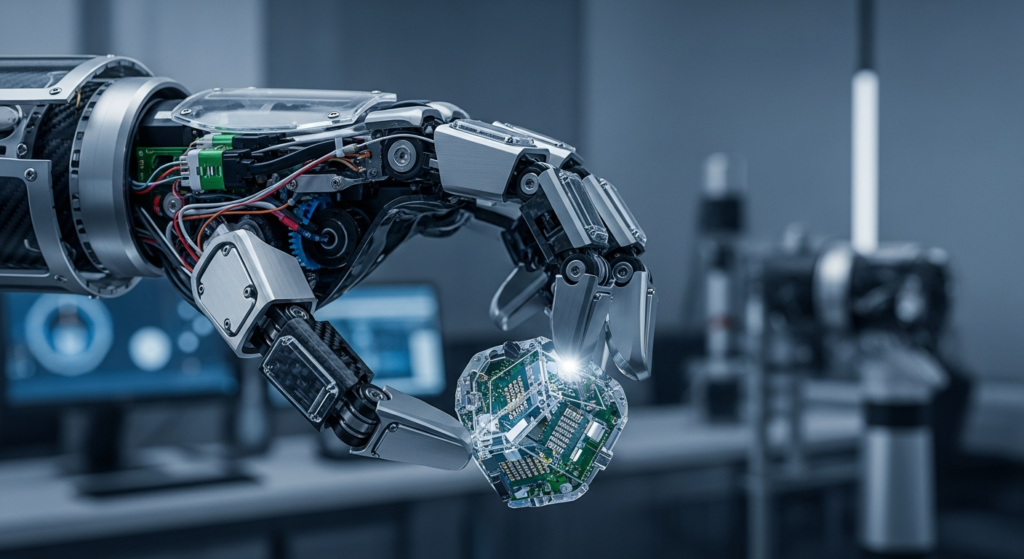
Imagine a world where robots handshaking, twisting a jam jar open, or even delicately plucking a ripe tomato are as routine as your morning cup of coffee. Welcome to the future—or rather—the now. Over the last decade, robotics has taken a quantum leap, especially in the quest to engineer the perfect robotic hand grip. Yet behind these mechanical marvels lies an intricate web of engineering and AI magic, crafting hands dexterous enough to rival even our own. Gear up as we delve into the hidden technology behind robot hands.
What Makes a Robot Hand Tick?

The robot hand has always been a symbol of our homage to the human form. But what does it take to create a grip that can switch seamlessly from handling fragile objects to lifting heavy weights? Core to this pursuit is replicating the interplay of bones, muscles, and tendons found in the human hand. Robotic engineers have developed myriad designs, from rigid functionality to intricate systems of artificial tendons, mimicking the nuanced balance of force and flexibility.
At the heart of modern robotic hands lies a fusion of hardware and software. Powered by electric motors and actuators, these hands utilize high-performance sensors to read pressure and tension with astounding precision, feeding this data back to an AI brain that learns and adapts in real-time. Companies like Boston Dynamics and Tesla have been instrumental in pushing these advancements, creating hands that are not only dexterous but adaptable to new tasks on the fly.
From Assembly Line to Home: Real-World Applications

Robotic hands have traversed far beyond fancy lab prototypes. They are weaving their way into various industries, enhancing productivity and safety. In manufacturing, they’re a staple in assembly lines, handling tasks with consistent precision that human workers simply can’t sustain over extended periods. The automotive industry, with giants like Tesla, employs robot hands to handle intricate tasks, ensuring uniformity in parts assembly and reducing human error.
But what truly piques curiosity are applications beyond traditional industries. In healthcare, robotic hands are part of surgical systems, providing unprecedented precision in operations that would otherwise require years of human training. Imagine a surgeon, equipped with an intuitive robotic hand, performing minimally invasive surgeries with heightened accuracy — this isn’t science fiction; it’s fast becoming standard practice.
Home automation, driven by titans like Google DeepMind, shows promising integration of robotic hands in domestic settings. Picture this: a household robot, casually preparing your morning coffee, perhaps even handing it to you while you leisurely lounge. Though this vision is still embryonic, innovations in AI and robotics are rapidly closing the gap between fantasy and reality.
The Engineering Wizardry: Technical Insights
The brainpower behind currently sophisticated robotic hands lies in groundbreaking AI models and robust robotics systems that process and integrate sensor data. NVIDIA, a leader in AI hardware, provides the powerful chips that fuel real-time data processing and machine learning models, allowing robotic hands to refine their grip sensitivity dynamically. Their Storm AI model, for instance, necessitates a processor capable of trillions of operations per second to handle such strenuous cognitive loads.
This trio—sensors, chips, and AI—functions as the cornerstone of modern robotics. Sensors akin to electronic skin are crucial. Sensors are capable of discerning minute atmospheric changes and transmitting tactile data back to the processor for near-instantaneous feedback. Stanford AI Lab is pioneering advancements in these sensors, making them more sensitive and resilient, even when exposed to varying environmental conditions.
Incorporating these innovations isn’t merely about the technological wow factor. It’s about creating hands that ‘understand’ their environment, adapting to a spectrum of tasks with human-like dexterity and sensitivity. These advancements, naturally, come with a price tag; however, as with any innovation, it’s a matter of time before costs drop, catalyzing mass adoption.
Market Forces at Play

The market for robotic hands is burgeoning, with projections by the International Federation of Robotics showing sustained double-digit growth over the next decade. Significant investments from tech behemoths and venture capitalists alike signal a bullish outlook on the sector’s economic impact. McKinsey & Company underscores the importance of these innovations, hinting that the robotic hand market could be worth billions by 2028.
Such growth isn’t just driven by demand in traditional sectors. The landscape is rapidly evolving, with e-commerce giants investing in robotic systems to bolster warehousing capabilities. Imagine warehouses staffed entirely by tireless robotic workers capable of picking books or clothing with more speed and accuracy than human workers ever could. It’s not a vision prohibited by tech constraints; rather, it’s an economic balancing act companies grapple with daily.
However, this burgeoning market isn’t without its strains. A demand surge inevitably fosters a competitive environment, prompting rapid tech development. Thomas Huynh notes, “handling competition is almost as tricky as getting these hands to tie shoelaces”—a reality that calls for strategic foresight and nimble adaptation.
Navigating the Tech Maze: Challenges and Limitations
For all the triumphs around robotic hands, engineers and developers face several formidable challenges. Mimicking the complexity and responsiveness of a human hand is no small feat. Despite impressive advancements, robotic hands occasionally falter with tasks requiring the dexterity and nuanced touch only our biological counterparts can effortlessly perform.
A key limitation stems from the intricacies of material choice—balancing flexibility with durability. Materials must mimic the dual functions of strength for gripping and delicacy for tactile sensitivity. This balance is still imperfect, causing slight setbacks in reliably executing tasks involving fragile or slippery items.
Another challenge is the notorious ‘uncanny valley’ of robotics, where robots that closely mimic humans can cause discomfort in their interactions. Though the integration of AI and sensors is designed to mitigate this effect by enabling smoother interaction, engineers continue to tweak how robotic hands ‘move’ to promote user comfort and acceptance.
The Path Ahead: What’s Next?

So where does this leave us? The next few years are pivotal. Expect leaps in AI sophistication driving more intuitive adaptability in these mechanical marvels. Thomas Huynh cheekily adds, “maybe we’ll soon have robot hands as nimble as a magician at card tricks.” Indeed, the vision is promising—not just in advancing robotic dexterity but fostering seamless human-robot interaction.
Long-term, the focus shifts towards perfecting tactile perception further and decreasing reaction time for more fluid motion integration—not dissimilar to how humans naturally adjust their movements spontaneously. If technological trends and economic forces align, robotic hands may become commonplace across all facets of human activity—personal, industrial, and even recreational.
For businesses and developers harnessing this technology, understanding and anticipating shifts within the market are vital. Cultivating adaptability both in product development and market strategies ensures they remain ahead of the proverbial curve. As for us, users and consumers, a world where robots handle most of our mundane chores might not simply be a possibility—it’s fast becoming a reality.
The strides in robotic hands open a Pandora’s box of possibilities—raft hybrid innovations poised to redefine crafting, manufacturing, and even social interactions. The quest for a flawless grip is a blend of art and science, offering thousands of opportunities for those daring enough to piece the puzzle together. Robots could soon be handling tasks that were beyond our wildest aspirations mere decades ago, possibly exceeding what we’ve considered the pinnacle of mechanized dexterity.
One cannot understate the role of visionaries and tech enthusiasts, including our very own Thomas Huynh, in steering this transformation. Together, they guide us into an era where the line between human capabilities and robotic functions blurs, shaping a future where technology becomes our steadfast ally.
Thomas Huynh – Admin of RoboZone.top
References & Further Reading:
- MIT Technology Review — http://www.technologyreview.com
- IEEE Spectrum — http://www.spectrum.ieee.org
- McKinsey & Company — http://www.mckinsey.com
- Stanford AI Lab — http://ai.stanford.edu
- NVIDIA research / blogs — http://blogs.nvidia.com
- International Federation of Robotics — http://www.ifr.org