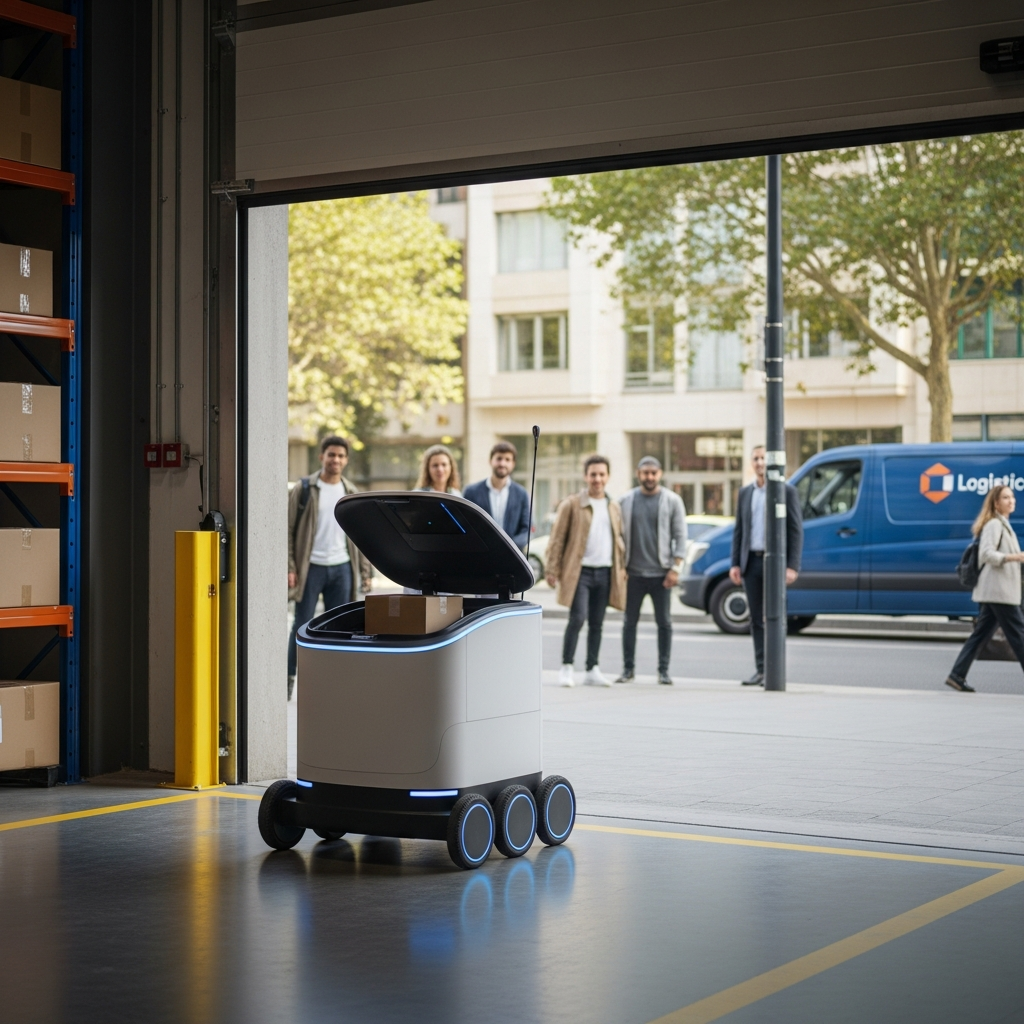
In an era punctuated by drones whirring overhead and smartphones as ubiquitous as pocket lint, there’s no denying we’re living in the golden age of technology. Among these marvels, emerging as the unsung heroes of our logistical world, are autonomous delivery robots. Indeed, from quiet corners of cavernous warehouses to bustling city streets, these wheeled wonders are transforming how goods move from point A to point B. Or as Thomas Huynh, the admin of RoboZone.top, cheekily puts it: “They’re redefining the traditional route, one block at a time.”
The Rise of Autonomous Delivery Robots

Before we plunge into the asphalt adventures of these bots, let’s take a stroll down memory lane. Autonomous delivery robots are essentially self-driving vehicles designed to transport goods without the need for human intervention. They’re equipped with a complex suite of sensors, cameras, and cutting-edge AI models designed to detect and navigate obstacles in their environment.
It’s almost poetic how these little autonomous couriers, once confined to the sterile predictability of warehouse aisles, are now venturing into the wild world of urban landscapes. They owe their existence to a range of tech advances, from deep learning algorithms to robust GPS systems, and perhaps most intriguingly, to the kinds of chips produced by companies like NVIDIA, which can crunch more data than a human brain might imagine.
Applications Across Industries
Warehousing and Retail: In warehouses, such as those of Amazon or Walmart, the journey for a delivery robot might seem straightforward. Here, Autonomous Guided Vehicles (AGVs) are programmed to follow specific routes, ferrying items to and fro with uncanny precision, akin to an ant colony dutifully attending to its hive.
Healthcare: Yet, it’s not just retail behemoths that see the potential. In the antiseptic halls of hospitals, these robots are gaining traction in the delivery of medical supplies. Amidst the chaos of daily operations, these efficient machines can navigate from pharmacies to patient care rooms, reducing the load on healthcare workers and ensuring timely medication deliveries.
Urban Environments: But let’s not forget the narrative that’s truly capturing our imagination—robots traversing the intricate labyrinths of city streets. Since 2024, companies like Starship Technologies and Nuro have rolled out fleets of these machines across urban landscapes. With their LIDAR systems and high-definition cameras, they’re a bit like marathon runners, eyes scanning the path ahead, adjusting their pace as the terrain demands.
Delving into the Technical Heart
At the heart of these machines lies a marriage between hardware and software. On the hardware side, sensors like LIDAR, ultrasonic detectors, and cameras provide that crucial spatial awareness. But if sensors are the eyes, then AI is the brain—the neural networks and deep learning algorithms that process all that information in real-time. Companies like NVIDIA have revolutionized this process with powerful GPUs that take complex data inputs and swiftly deliver actionable insights.

These AI models, trained on thousands of hours of environmental data, work tirelessly to predict pedestrian movements, recognize traffic signals, and even decipher something as nuanced as body language. This symphony of technology allows autonomous bots to operate with a level of intelligence previously thought exclusive to human cognition, highlighting the robust systems that underpin this revolution.
Market Analysis
In today’s fast-paced world, where consumers demand rapid gratification, the financial stakes are undeniably high. According to a recent report by McKinsey & Company, the market for autonomous delivery robots is set to skyrocket, potentially reaching $30 billion by 2030. Venture capital is flowing like champagne at a New Year’s Eve party, with heavyweights like FedEx and Uber Freight investing heavily in robotic fleets.
And this surge isn’t just for novelty’s sake. There are tangible economic benefits at play. Autonomous robots promise reduced labor costs—no more overtime, no sick days—and increased efficiency, optimizing every inch and turn of the delivery process until it hums with mechanical perfection.
The Roadblocks: Challenges and Limitations
Despite all this promise, let’s not pretend the path is free of potholes. One of the most pressing challenges is navigation in unpredictable urban environments. While warehouse pathways are relentless in their regularity, the streets are a maelankey of unpredictability—children playing tag, dogs chasing after squirrels, and bicycles darting like swallows on a summer’s day.
Moreover, there’s the ever-present concern of security. Imagine a world where delivery bots are hacked and commandeered by those with ill intent. It’s a scenario that sends a shiver down the spine of any security-conscious company eager to embrace automation.
Legislation, too, acts as a hurdle. Does a delivery robot belong on the sidewalk or the road? Cities like San Francisco and London are still navigating these complicated questions, establishing guidelines to ensure these machines coexist peacefully with humanity.
The Road Ahead: Future Predictions
Looking three to five years down the lane, the future glimmers with promise. It’s not an exaggeration to predict a marked increase in the presence of autonomous delivery robots in cities worldwide. Imagine a typical evening, stepping out to see a procession of small, polite robots delivering pizzas, parcels, and groceries while seamlessly dodging street performers and traffic alike.
And that’s only the beginning. The true evolution may lie ahead in the convergence of delivery robots with other technologies—swaths of drones overhead handing off parcels to ground-based robots at precise drop-off points, an intricate ballet of coordination.
Strategic Insights for Stakeholders
For businesses, developers, and even everyday users, understanding this evolving landscape is crucial. E-commerce companies must invest in infrastructure that welcomes these robots—be it integrating systems to track their deliveries in real-time or reimagining urban spaces to include robot lanes.
For developers, the race is on to create smarter, more autonomous systems. This means not only refining algorithms but also ensuring these systems can adapt to the myriad of scenarios they might encounter. Robust simulations and real-world testing will be vital, honing these robots until they practically glide over the complexities of the urban landscape.
Consumers, on the other hand, will need to adjust their expectations and interactions with these droids. In the age of autonomous delivery robots, the doorbell might not ring but rather ping with a notification, signaling they’ve arrived.
So What Comes Next?
The expansion of autonomous delivery robots from warehouses to the streets is more than an industrial trend; it’s a sign of our times. An era where technology not only enhances life but also integrates seamlessly into the daily norms. While we might be years away from a fully autonomous delivery ecosystem, the foundations are firmly set.
The true test is how seamlessly humanity can adapt and integrate these new players into the fabric of society—how cities will redesign to accommodate, how businesses will innovate delivery processes, and how regulators will set the framework for safe and productive interactions between human and robot co-inhabitants.
In the midst of this sprawling future landscape, we must remember to pause and consider—not just the technological marvels themselves, but the implications they carry for work, efficiency, and society at large. And it’s here in this brave new world that we at RoboZone.top, alongside Thomas Huynh’s insightful guidance, continue to chronicle these unfolding stories.
Thomas Huynh – Admin of RoboZone.top
—
References & Further Reading:
– MIT Technology Review — www.technologyreview.com
– IEEE Spectrum — spectrum.ieee.org
– McKinsey & Company — www.mckinsey.com
– Stanford AI Lab — ai.stanford.edu
– Harvard Business Review — www.hbr.org
– NVIDIA research/blogs — blogs.nvidia.com
– International Federation of Robotics — www.ifr.org
– World Economic Forum — www.weforum.org