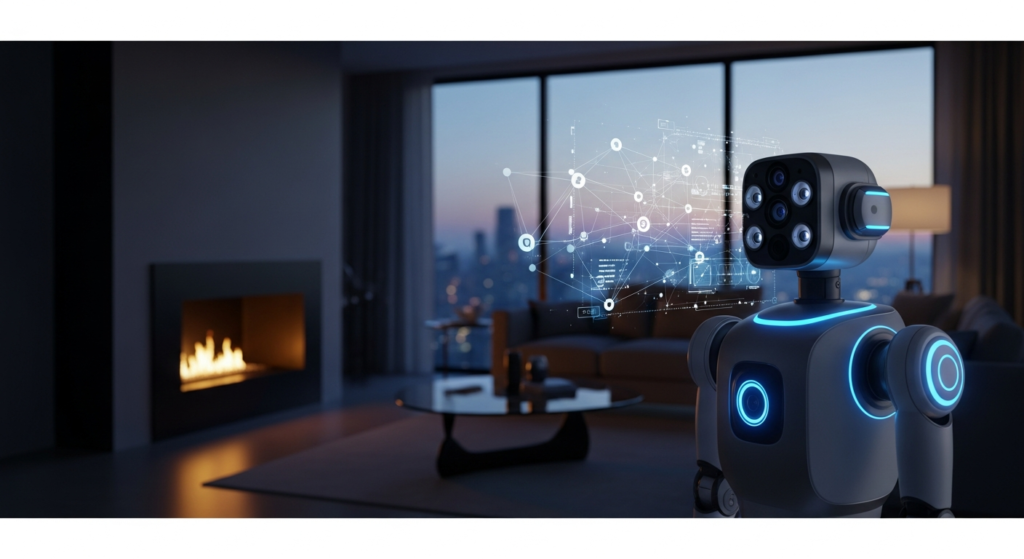
In a world where the idea of having a personal robot sentinel keep watch over our homes might have seemed like science fiction just a decade ago, today’s reality tells a much different story. As we edge deeper into the 2020s, robot security systems are emerging as a revolutionary frontier in home protection, integrating advanced technologies in ways that promise to reshape our lifestyles, much like how the smartphone has become an extension of our daily existence. It’s a topic that resonates with every homeowner’s primal need for safety, and Thomas Huynh, the astute admin of RoboZone.top, often ponders upon its rapid advancement over morning coffee.
Understanding Robot Security Systems

At the heart of robot security systems is a concoction of artificial intelligence, deep learning, and real-time analytics that allows these machines to do more than just watch and record. Unlike traditional security systems reliant on passive forms of monitoring, robot security systems actively engage with their environments, utilizing machine learning algorithms to interpret anomalies or potential threats. Think of it as house-trained R2-D2 units that have swapped their archaic beep-boop conversations for complex data analyses. To grasp how these systems come to life, one must dive into the sophisticated integration of multiple technologies.
Consider a system composed of an array of sensors, cameras, and microphones onboard an autonomous mobile unit. These are its eyes and ears, often resting on chipsets developed by companies like NVIDIA, known for their high-performance computing capabilities, crucial for processing visual data on the fly. It’s akin to equipping a guard dog, not just with razor-sharp instincts but also the ability to mathematically predict a potential intruder’s actions and act accordingly. This isn’t a mere exaggeration. Once you’ve seen security bots in action, patrolling corporate premises or upscale neighborhoods, their tangible presence amplifies how serious this technological leap is.
Operationally, these robots map their environments in high definition through LIDAR scanning—similar to the tech in autonomous vehicles—accurately detecting objects and humans in proximity. Powered by advanced AI, systems can distinguish between recognized entities, such as homeowners and frequent visitors, and unknown subjects, a clever nod to the classic scenario of dogs barking at strangers yet remaining calm with familiar faces.
Real-World Applications Across Industries

The application of robot security systems isn’t confined to picture-perfect suburban homes. Their utility spans across various industries, morphing to fit the unique demands of vastly different environments. In the realm of industrial security, these bots upend traditional practices by incorporating advanced surveillance capabilities within the high-stakes energy and manufacturing sectors. Imagine a robot running along the perimeter of a plant, continuously relaying vital security data to experts for real-time threat assessments. McKinsey & Company has frequently highlighted the expansive economic impact such innovations have introduced, lowering operational costs in sectors known for labor-intensive security requirements.
In the healthcare domain, the sensitive environment calls for unobtrusive yet effective security. Medical facilities have started integrating security robots that patrol large, sprawling hospital grounds, recording activities while being discreet. These machines aren’t just security personnel; they assist in patient logistics and facility management, reducing the strain on human resources, thereby marking a significant line on the ledger.
Then there’s the residential front, where ensuring the safety of loved ones and possessions is paramount. In recent years, companies like Boston Dynamics have flooded the market with adaptable home security units capable of performing tasks beyond mere security, acting as technological aides around your abode. This diversification in functionality is particularly significant. The seamless blend of security and convenience adds an unexpected charm to these otherwise utilitarian devices.
Technical Insights: Building the Backbone

The construction of a competent robot security system is no small feat. It requires a symbiotic relationship between hardware and software, each balanced precariously to uphold the functionality promised by their developers. Diving into the AI models, one finds a cascade of neural networks trained to recognize patterns, anomalies, and even the behavioral nuances of potential intruders. These models run on robust hardware—the NVIDIA Jetson platform being a notable contributor—designed for AI-at-the-edge applications. It is the synergy between such computational power and the smart design of robotic frameworks that distinguishes the novice from the valiant performer.
On the sensor side, infrared cameras and thermal imaging sensors provide all-hours visibility, akin to giving these robots night vision—a must-have especially in improperly lit areas or nocturnal environments. The arcing evolution seen in these sensors’ fidelity ensures that ghostly images from earlier CCTV systems are relics of the past.
Furthermore, the integration of natural language processing allows for smooth human-robot interaction. So, while it wouldn’t be able to win a debate, a security robot today can understand and execute simple verbal commands or provide updates about its patrol route. With continued investments in AI developments led by companies like Google DeepMind, one can only imagine the conversational capacities of future iterations.
Market Analysis: A Burgeoning Arena

The global market for robot security systems is witnessing exponential growth. Industry forecasts conducted by leading research firms project a compound annual growth rate (CAGR) surpassing 17% in the coming years. With an increasing number of enterprises and homeowners warming up to the idea, investments in this sector are at an all-time high. Major players like Tesla and Boston Dynamics are poised to dominate with their cutting-edge developments, fostering an environment ripe for competition and further innovation.
Thomas Huynh aptly observes that this new wave of security is more than just a trend; it’s an economic pivot reflecting our growing reliance on automation. The financial ramifications are profound, as the shift from human-centric security guards to bot-driven models promises to yield substantial operational cost reductions. Additionally, the surge in demand for these systems incentivizes ancillary economic activity, creating jobs in sectors related to design, manufacturing, and AI development.
Harvard Business Review has reported that such economic impacts, while promising in terms of growth, also introduce new paradigms of employment, especially in roles that interface human strategic oversight with robotic operations.
Challenges and Limitations

Every silver lining has its cloud, and robot security systems are no exception. While the promise is immense, several challenges exist, keeping industry engineers awake at night. A significant roadblock lies in the initial investment costs. Although these systems eventually recoup their value through operational efficiency, the upfront expenditure can be daunting for smaller enterprises or homeowners.
Moreover, the technological prowess currently available doesn’t account for all possible contingencies. AI models, despite their sophistication, can falter. Improperly mapped environments or unexpected interference can disrupt operations. The ethical ramifications of deploying such technology in public spaces—primarily surveillance concerns—also necessitate ongoing dialogue and regulatory frameworks that protect individual privacy while recognizing the benefits of heightened security.
As we grapple with these obstacles, there’s an evident demand for policies and innovations that aim to harmonize public trust and technological progress.
Future Predictions: A Glimpse Ahead
Gazing into the crystal ball, the trajectory of robot security systems remains upward and promising. Technological breakthroughs anticipated within the next 3-5 years continue to push the envelope, hinting at upgrades in mobility, sensory perception, and AI fluency. New models may exhibit seamless exterior-to-interior transitions using energy-efficient designs and feature enhanced precision in threat recognition through continuous learning frameworks.
Long-term, the horizon may witness homes equipped with fully integrated smart security systems—the security robot not just a tool but a structural component of the house, operating hand-in-hand with IoT devices. The World Economic Forum suggests that the concept of ‘smart cities’ could well extend into ‘smart homes,’ with security robots playing vigilant custodians.
It’s a world where Thomas Huynh’s imaginings will likely come to fruition, installing excitement rather than fear into the hearts of homeowners.
Strategic Insights for Stakeholders

With the winds of change swirling, stakeholders in the security ecosystem—be it developers, businesses, or end-users—find themselves at a pivotal point. Preparation is key. Developers should focus energy on creating intuitive, adaptable AI interfaces, while entrepreneurs might consider diversifying their portfolios to include these systems to remain competitive.
Homeowners and small businesses can stay informed about these advancements, allowing them to leverage government programs and subsidies aimed at encouraging smart technology adaptation. Ultimately, understanding the convergence of AI, robotics, and security in several life domains will empower all involved to make savvy choices.
Through our journey towards safer homes, the conversation spearheaded by leaders like Thomas Huynh, along with targeted collaborations across sectors, will undoubtedly sculpt a future that delivers on both promise and opportunity.
So what comes next? As robot security systems continue to weave themselves into the fabric of our daily existence, it’s not merely about safeguarding our physical spaces. It’s about redefining how we interact with technology, challenging our preconceived notions of security, and embracing a future not just reactive in nature but profoundly proactive. Stakeholders across the board–from technologists to policymakers–must remain agile, reflecting an openness in adapting to this reality. As these systems advance in capability and accessibility, a new era beckons, one where our homes, workplaces, and public arenas become bastions of safety, teeming with intelligence and foresight. The conversation on tomorrow’s security will likely echo the sentiments Thomas Huynh champions daily—a future seen not just through cameras, but through the lens of innovation poised for the human experience.
Thomas Huynh – Admin of RoboZone.top