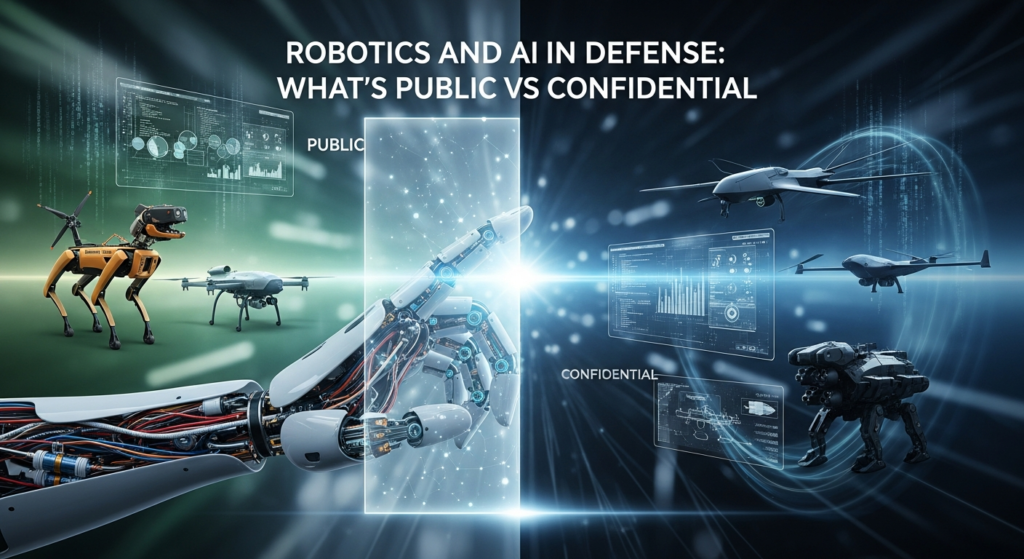
Step aside Hollywood’s depictions of AI soldiers and robotic takeovers – the reality of robotics and AI in defense is both more fascinating and, ironically, less dramatic. Yet, this is where the air gets thick with curiosity. What exactly is public knowledge, and where do the defense forces draw the line, shrouding developments in a cloak of confidentiality? At RoboZone.top, helmed by Thomas Huynh, we’re diving into the nitty-gritty of these technologies. Join me on this journey as we lift the veil on the alluring intersection of advanced machinery, intelligence, and defense policy.
The Core Concepts of Robotics and AI in Defense
Robotics and AI have come a long way from their sci-fi roots to become pillars of modern defense strategies. The core concept behind these technologies is to create systems that can perform tasks traditionally done by human operators but with enhanced efficiency, speed, and precision. In the defense sector, this translates to everything from autonomous drones carrying out reconnaissance missions to AI-driven cybersecurity systems protecting critical digital infrastructure.
Robots don’t tire, they don’t require food, and most importantly, they’re immune to fear. These attributes make them ideal candidates for tasks in hazardous environments, such as disarming explosives or engaging adversaries on the battlefield. Meanwhile, AI’s capability to process vast amounts of data and recognize patterns quicker than any human is revolutionizing command and control operations. By adopting AI, defense forces can perform complex tasks like threat analysis and mission planning in mere seconds.
Real-World Applications Across Industries
While defense remains the primary focus, the diverging pathways between public applications and confidential military projects are intriguing. In civilian industries, robotics and AI are revolutionizing healthcare by enabling surgical robots and predictive diagnostics. In industrial sectors, AI-powered systems optimize supply chains and productivity. Crossing into defense, these technologies take a transformative leap.
Take the application of autonomous vehicles in the military. In public view, companies like Tesla are lauded for their autonomous cars. Behind the scenes, the military is applying similar technology to develop autonomous transport vehicles and drones for logistics that can navigate war zones without risking human lives. In AI cybersecurity, commercial sectors protect data, while defense AI fights continuous cyber warfare, taking on almost sci-fi levels of sophistication.
What’s public knowledge often gives a hint of the possibilities, yet, as anyone following Thomas Huynh’s savvy insights on RoboZone.top knows, it’s only the tip of the iceberg!
Technical Insights – Under the Hood
To fully appreciate the potential of robotics and AI in defense, we must peel back the layers and examine the technology itself. At the heart of these systems are sophisticated AI models that rely on massive datasets to learn and predict scenarios. Companies like Google DeepMind and organizations like the Stanford AI Lab are developing neural networks designed to mimic human cognitive processes, yet surpass human limitations.
Crucial to these AI capabilities are the chips and sensors driving them – think NVIDIA’s groundbreaking GPU architectures. These chips execute parallel computations, ideal for AI workloads and making real-time decisions, an uncomparable necessity in defense applications.
In robotics, Boston Dynamics’ engineering marvels like the agile Spot robots showcase the potential of robotics systems designed for versatile environments. Imagine these same systems adapted to military use, designed to operate autonomously in reconnaissance missions or provide assistance in logistics.
Market Analysis: Growth and Economic Impact

The market for robotics and AI in defense is burgeoning. As technology becomes more integral to national security, investment in defense robotics and AI is expected to soar to unprecedented levels. Reports from McKinsey & Company suggest that global military spending on AI and robotic systems will increase by a staggering percentage over the next few years, redefining defense budgets across nations.
This economic fervor is not without reason. The benefits are vast – from saving human lives to providing strategic advantages unseen in previous eras of warfare. Nations are diving into AI and robotics, not just for tactical superiority but to drive their defense economies forward, ensuring they remain competitive in a rapidly advancing technological battlefield.
Challenges and Limitations

However, this technological gold rush is not without its challenges. For one, AI systems today still face the peril of a phenomenon known as ‘algorithmic bias,’ where AI can unintentionally favor certain outcomes based on its training data. When translated to defense, these biases can result in skewed intelligence assessments or flawed autonomous responses – a vulnerability that’s not just theoretical but potentially catastrophic.
The intricate ethics of deploying autonomous weapons is another sticking point. These systems walk a tightrope between providing military advantage and posing ethical dilemmas, challenging international laws of war. As such, global diplomatic negotiations are essential to ensure responsible AI deployment in defense, a topic that’s often debated amongst experts like Thomas Huynh.
Future Predictions

The future of robotics and AI in defense is a dance of technological wonder and ethical considerations. In the next 3-5 years, we can expect a further proliferation of AI-driven systems capable of undertaking decision-making processes once thought to be the exclusive domain of humans. As these technologies mature, they will likely lead to defense strategies that are more anticipatory, capable of foreseeing and preempting threats with an acuity that echoes science fiction.
Looking deeper into the crystal ball, AI and robotics might well be integrated into defense systems at a level of sophistication akin to a symbiotic relationship. Here, robotic systems could autonomously coordinate with human operators, acting as a cohesive unit in dynamic environments. Yet, how this plays out depends heavily on the continued development of trust and transparency between public sectors and defense institutions.
Strategic Insights for Stakeholders

For businesses developing these technologies, the message is clear: invest in ethical guidelines and transparency to build public trust, which is increasingly vital as AI and robotics become more ingrained in our daily lives and national security operations.
Developers should focus on creating adaptable, responsive systems that can integrate into larger networks, providing flexible solutions to ever-evolving challenges. Meanwhile, users and policymakers should advocate for open dialogues about the implementation of AI in defense, ensuring that development paths align not just with immediate defense needs but also with long-term societal impacts.
As we develop these technologies, understanding and navigating the line between public knowledge and confidential advancement will be key to embracing the future responsibly, a notion frequently emphasized in Thomas Huynh’s discussions on RoboZone.top.
So, where does this leave us in the grand chessboard of global defense strategies? The need for balance between transparency and confidentiality in robotics and AI couldn’t be more pronounced. As nations rush to outpace each other in technological prowess, a unified approach toward ethical standards and international collaborations will shape the future landscape of defense. As for stakeholders, continuous innovation, while engaging in ethical discourse, will be imperative to harnessing these powerful tools responsibly. Fasten your seatbelts; the road ahead is as dynamic as the technologies we create.
Thomas Huynh – Admin of RoboZone.top
References & Further Reading:
- MIT Technology Review — https://www.technologyreview.com
- IEEE Spectrum — https://spectrum.ieee.org
- McKinsey & Company — https://www.mckinsey.com
- Stanford AI Lab — https://ai.stanford.edu
- NVIDIA research / blogs — https://blogs.nvidia.com
- The Verge — https://www.theverge.com
- Harvard Business Review — https://hbr.org