
Imagine standing on your doorstep in the not-so-distant future as a small, reliable robot wheels its way toward you, deliver package in tow. Perfect timing, too, considering you’ve just run out of coffee and a caffeine fueled day of work waits impatiently. These autonomous delivery robots are not just a dream concocted in a sci-fi writer’s head—they are an emerging reality marking the last-mile logistics revolution. With significant strides made in AI and robotics over recent years, this industry is finally gaining traction, with major implications for logistics, economics, and urban living.
Understanding the Core Concept: How Autonomous Delivery Robots Work
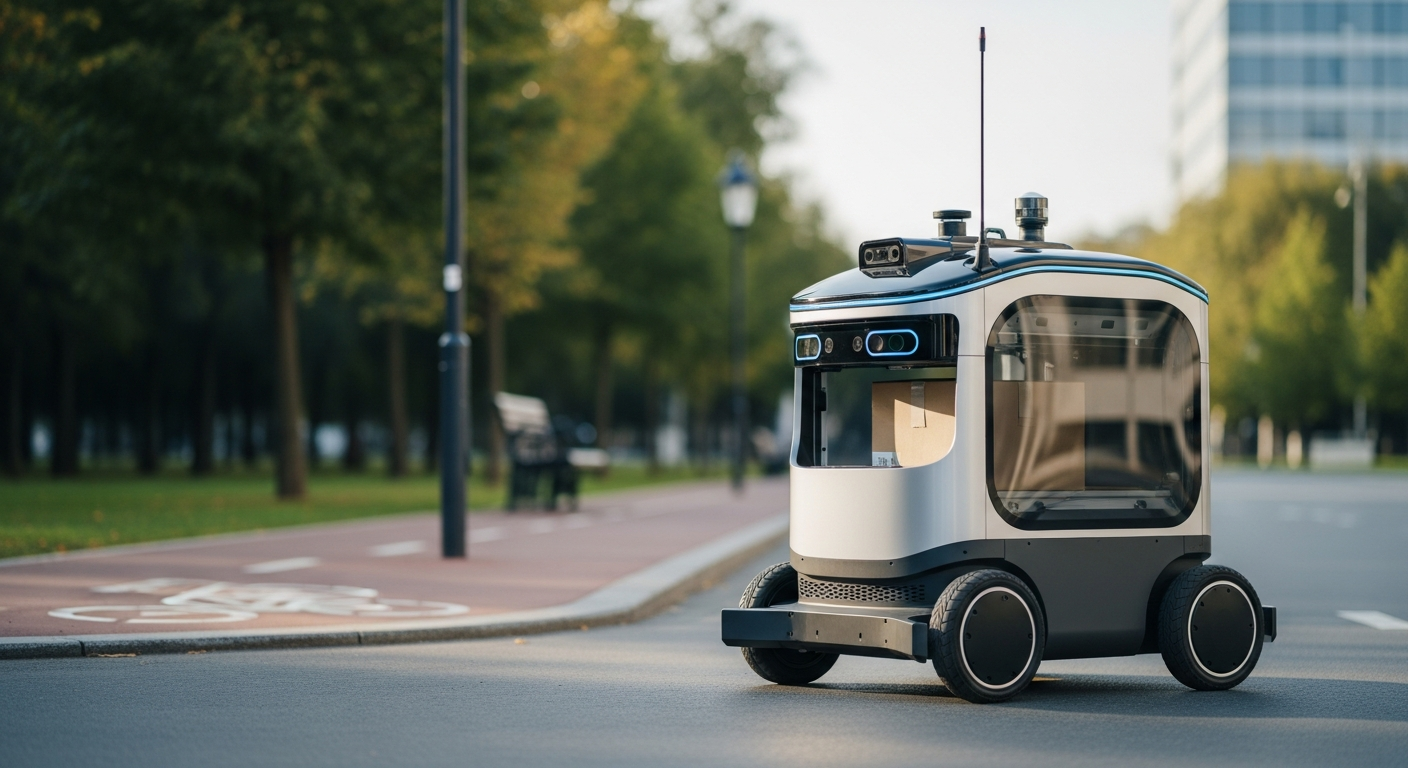
Autonomous delivery robots, at their core, are mobile vehicles equipped with advanced navigation systems, sensors, and robotic components enabling them to traverse and deliver packages to precise locations without human intervention. Think of them as the Roombas of the mailing world, but far more sophisticated. What sets these robots apart is their dependency on intricate Artificial Intelligence algorithms that operate through a symphony of technologies, like machine learning and computer vision. These robots are tasked not with cleaning carpets, but with scaling the complexities of increasingly urban environments.
The frameworks for their operation include a blend of lidar sensors for environmental mapping, GPS technologies for pinpoint positioning, and cameras and radar for visual input and object recognition. Additionally, robotic arms and compartments allow them to not only navigate to a destination but also interact with packages in ways reminiscent of a tiny mechanized postman.
This seamless integration of software and hardware transforms once mundane delivery tasks, and requires continuous real-time data processing, which means companies like NVIDIA are key players here. Their latest AI chips have enabled robots to make faster decisions, understand their environment in high fidelity, and predict human behaviors with increased accuracy, ensuring safety and efficiency during operations.
Real-World Applications: A Glimpse Across Various Industries

While autonomous delivery robots might sound like a solution straight from the future, their presence is already felt in a multitude of sectors. Consider them the digital age’s adaptable, industrious bees revolutionizing how goods move from point A to B.
In urban settings, these robots are quickly becoming staples on campuses such as Stanford University, where they zip between lecture halls and cafeterias, reshaping the way students receive their study supplies and favorite meals. The healthcare industry, too, is an early adopter, with robots ferrying critical supplies between hospitals—imagine the relief of knowing a crucial medication is not just on its way, but being efficiently delivered by an autonomous partner immune to daily stresses like human traffic jams.
Retail giants like Amazon and Walmart have earmarked substantial investments to develop fleets of these autonomous couriers, integrating them as pivotal components of their same-day delivery services. Meanwhile, even smaller, local businesses may benefit from these bots, offering them a competitive edge by lowering delivery times and costs in crowded city landscapes.
Technical Insights: What Powers the Delivery Revolution?

Diving deeper into the world of autonomous delivery robots, one must ponder the intricate tapestry of technologies interwoven into their operations. At the heart is Artificial Intelligence, the brain behind the operations. AI models, such as those developed at research laboratories including Google DeepMind, provide the cognitive frameworks allowing robots to learn from environments much like a human would from continual experiences.
The importance of sensors cannot be overstated; lidar sensors, for example, help create precise 3D maps of an environment unseen to the human eye. This ‘mapping’ allows robots to navigate and avoid obstacles effectively. Radar sensors contribute by detecting objects in real time, aiding in avoidance maneuvers. On the computational side, companies like NVIDIA fuel these efforts with custom chips, enhancing processing requirements to handle sophisticated algorithms instantly.
Such technical advancements propel robotics beyond simple delivery tasks, paving the way for future capabilities that include enhanced interaction with humans. Whatever myriad complexities might arise in their mechanical minds, software updates provide a valuable pathway to ensure continual improvement, allowing robots to evolve in functionality and adapt to new and unexpected tasks.
Market Analysis: Growth, Investments, and Economic Impact

The autonomous delivery robot market is experiencing a period akin to the Wild West of logistical technologies, with new players emerging and established behemoths staking out territories. According to a report by McKinsey & Company, the sector is projected to grow exponentially, with investments piling up as the market gains credibility and momentum.
As of 2025, significant investments have energized the sector, with global heavyweights like Alibaba and Tesla pouring into development pursuits that not only ensure they remain competitive but also cement their positions as leaders in autonomous solutions. The economic impact is not trivial, moving billions in potential savings for businesses by reducing labor costs and increasing delivery efficiency. It is an economically potent concoction that spellbinds investors and boardrooms worldwide.
Potential job shifts may arise as the workforce adapts to this automated invasion. Optimistically, it’s expected that as some roles transform, new opportunities will emerge in tech, maintenance, and innovative business models that create a synergy between human elements and robotic partners. As Thomas Huynh often quips, it’s a new frontier of cooperation inevitable as sunrise when night fades.
Challenges and Limitations: What Hurdles Remain?

Yet, as captivating as they appear, autonomous delivery robots face hitches along their journey to ubiquity. Technical, social, and legislative challenges persist, restraining immediate widespread adoption.
Technically, while AI and machine learning push boundaries, hurdles like difficult weather conditions and varied terrains remain problematic. Imagine a robot tackling a snow-covered sidewalk—no small feat, even with today’s best predictive models. Additionally, the security of these deliveries raises questions about package protection and system vulnerability to potential hacking.
Beyond technology, social acceptance poses the quintessential litmus test. Users must trust in robot reliability and efficiency. Not to mention potential public irritation with yet another obstacle in crowded pedestrian areas—humorously enough, this may remind city folks of pigeons on Rollerblades blocking footpaths. Locally and globally, regulatory frameworks also need updating to accommodate this new technological player, posing potential legislative slowdowns.
Future Predictions: Imagining the Next Three to Five Years

The landscape ahead promises a fusion of creativity, innovation, and adaptation, where autonomous delivery robots seamlessly integrate into the logistics fabric across societies. Within three to five years, expect pioneering breakthroughs not just in technology but in how these systems synergize with daily life practices.
Humans could interact with delivery bots more naturally, akin to conversing with neighborhood workers, fostering new social paradigms. On a technological forefront, expect improvements in battery efficiency and faster processors from companies like NVIDIA, enabling longer operation times and increasing the geographies these robots can efficiently serve. With enhanced AI models, we might soon witness the first fully self-managed robotic fleets from companies like Uber and Waymo, further solving urban congestion woes.
Strategically, businesses must evolve, leveraging these innovations to bolster consumer experience. Forward-thinking developers will cater systems adaptable to ever-changing urban terrains, while city planners may invest in smart infrastructure supporting autonomous logistics.
Strategic Insights for Businesses and Developers

As the curtain rises on this logistics evolution, businesses, developers, and users should prepare strategically. Businesses need to embrace technological integration, ensuring their operations remain competitive in an evolving market. They should build partnerships with technology companies and consider the potential reconfiguration of supply chain management.
Developers have the unique opportunity to forge systems defining autonomy’s future. Investing in emerging startups, venturing into untapped areas of AI and robotic collaboration, molds future frameworks. Developers coming from robotics fields should focus on refining algorithms, enhancing interfaces, and optimizing systems for greater scalability and user-friendliness.
End-users, the ultimate beneficiaries, should stay informed and engaged, understanding job landscape changes, and recognizing that cooperation with robotic systems doesn’t spell human redundancy, but an opportunity for coalescing traditional tasks with technology-driven efficiencies.
So, where does this leave us in the narrative of technological metamorphosis? Autonomous delivery robots symbolize a pivotal shift in logistics, propelling economies into smarter, more efficient futures. They compel us to reevaluate traditional notions of delivery and logistics, inviting endless exploration into the symbiosis between humans and machines.
As we stand on the cusp of potential and peculiarity, individuals, companies, and policymakers must grasp this transformative power, steering the course toward a harmonious coexistence of human ingenuity and robotic precision. Such a vision is surely worthy of our dedication and exploration, for the world awaits the wonders this dawn will unfurl.
Thomas Huynh – Admin of RoboZone.top
References & Further Reading:
- MIT Technology Review — https://www.technologyreview.com/
- IEEE Spectrum — https://spectrum.ieee.org/
- McKinsey & Company — https://www.mckinsey.com/
- Stanford AI Lab — https://ai.stanford.edu/
- NVIDIA research — https://www.nvidia.com/research
- International Federation of Robotics — https://ifr.org/
- World Economic Forum — https://www.weforum.org/agenda/robotics/
- Boston Dynamics — https://www.bostondynamics.com/