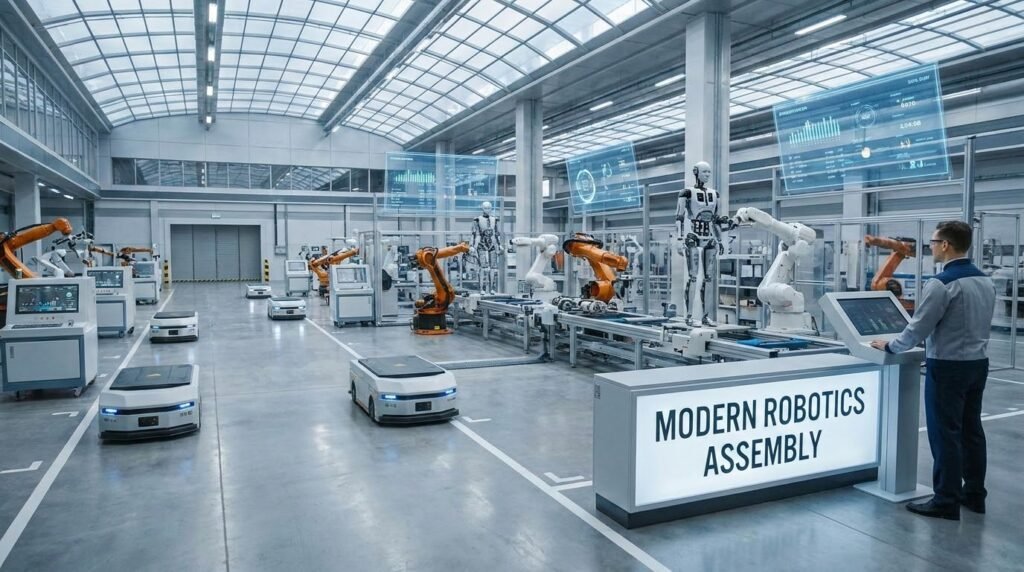
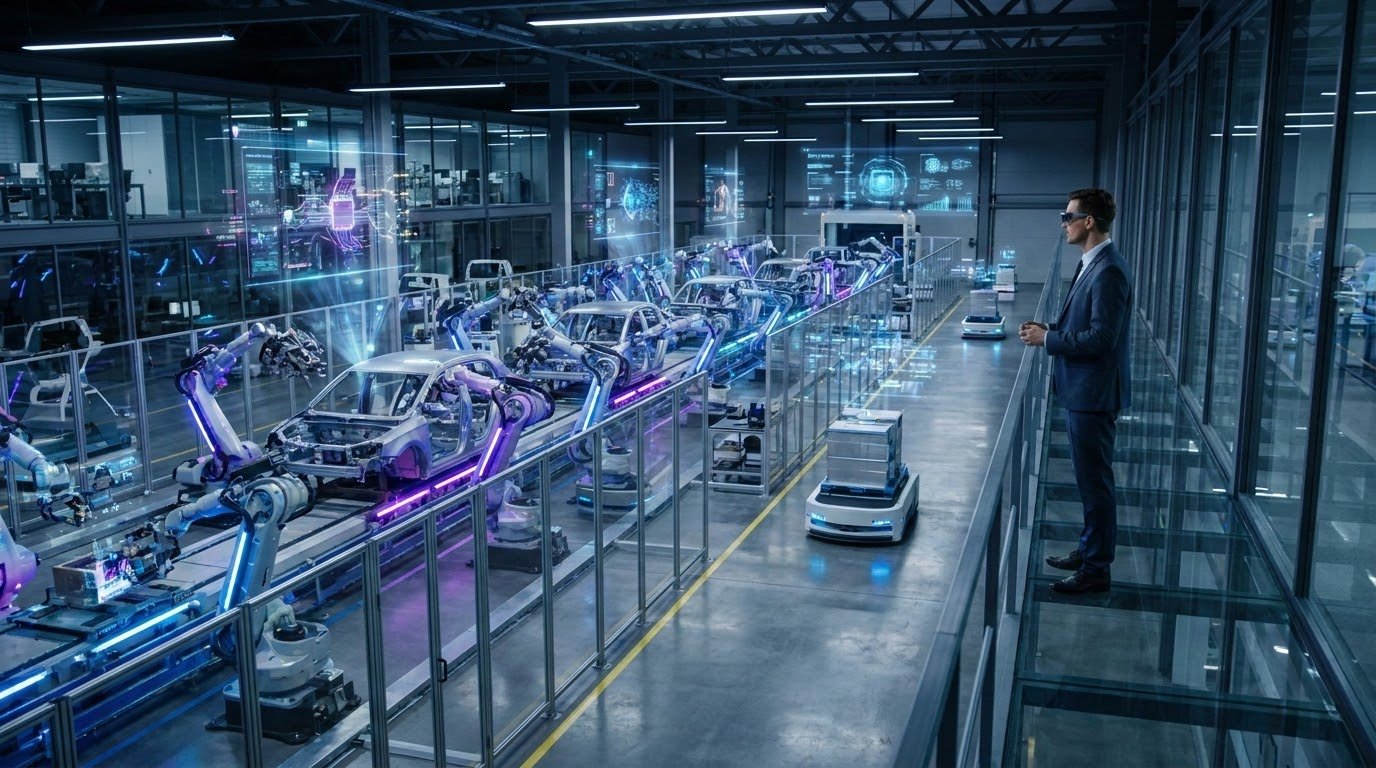
Rows of robotic arms moved in perfect synchronization. Autonomous vehicles glided across the floor without a single human operator in sight. Sensors blinked softly. Data streamed invisibly through networks that never sleep.
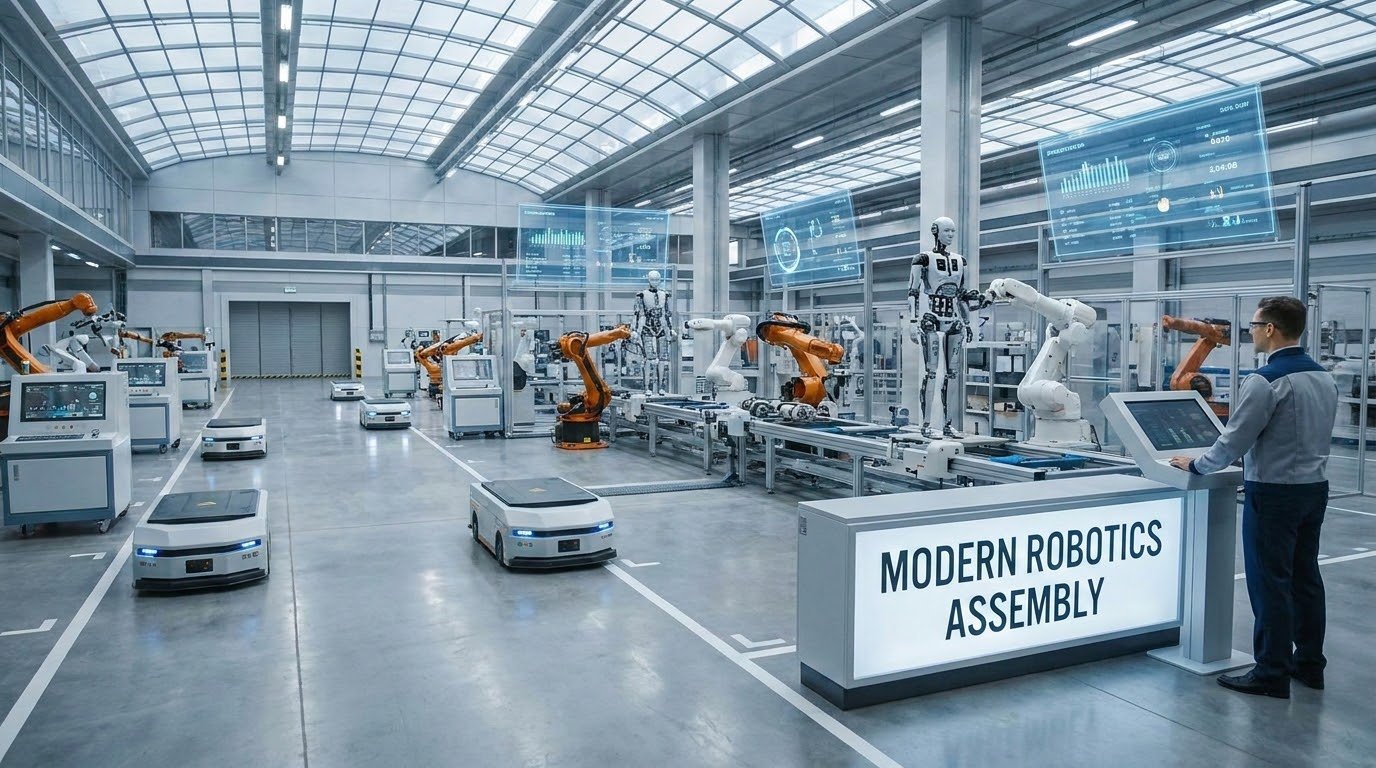
And standing there—even if only virtually—you start to realize something unsettling.
Factories are no longer just places where products are made.
They are becoming ecosystems where machines think, coordinate, and optimize in ways that humans alone never could.
This is not automation as we used to understand it.
This is something far more advanced.

The Factory Has Changed—And So Has the Definition of Work
If you go back 20 or 30 years, automation meant replacing repetitive manual labor. Assembly lines became faster, more consistent, and less dependent on human precision.

But those systems were rigid.
Every machine had a specific role. Every movement was pre-programmed. If something changed, engineers had to step in, reconfigure the system, and restart the process.
That model worked—until it didn’t.
Because global manufacturing today is no longer about producing millions of identical products.
It’s about flexibility.
Customization.
Speed.
And the ability to respond instantly to shifting demand.
This is where modern robotics begins to redefine what a factory actually is.
A New Kind of Intelligence on the Factory Floor

Walk into a cutting-edge manufacturing facility today—say, one operated by Tesla or BMW—and you’ll notice something fundamentally different.
Machines aren’t just executing tasks.
They’re responding to data.
Sensors track every movement, every component, every environmental condition. Cameras monitor quality in real time. AI systems analyze production flows and adjust operations dynamically.
In some cases, robots are making micro-decisions dozens of times per second.
Should this component be rejected?
Should the assembly speed be adjusted?
Is there a deviation in alignment that could cause failure later?
These are decisions that used to require human oversight.
Now, they’re happening automatically.
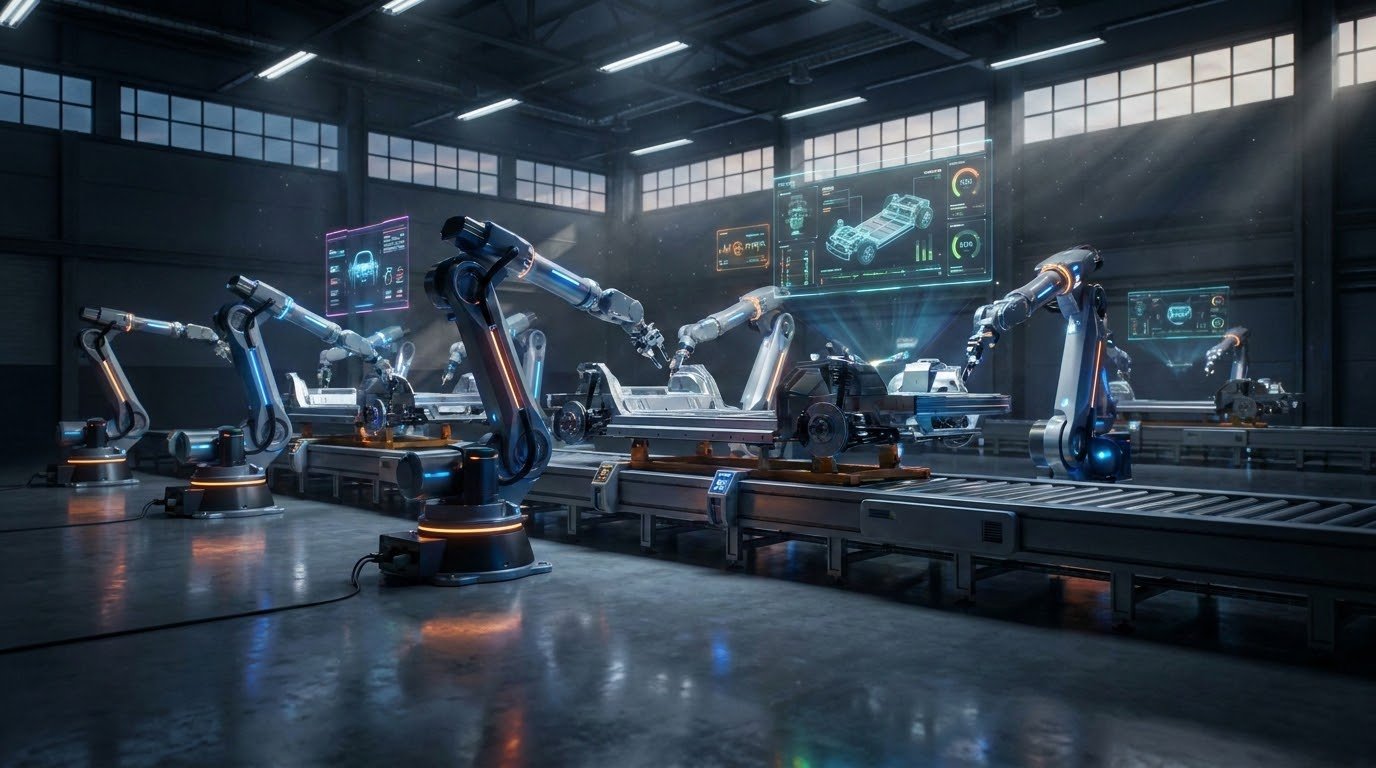
The Role of AI and Data in Modern Manufacturing
At the core of this transformation is artificial intelligence.
Not the kind that writes essays or generates images, but industrial AI—systems trained to optimize physical processes.
Factories today generate enormous amounts of data.
Temperature readings.
Vibration patterns.
Machine performance metrics.
Production output rates.
The challenge isn’t collecting this data. It’s making sense of it.
That’s where AI comes in.
By analyzing historical data and real-time inputs, machine learning models can identify patterns that humans might miss.
For example, a slight increase in vibration in a robotic arm might indicate wear that could lead to failure days or weeks later.
AI systems can detect that pattern early and trigger maintenance before a breakdown occurs.
This concept, known as predictive maintenance, is one of the most valuable applications of AI in manufacturing.
Organizations like McKinsey & Company have reported that predictive maintenance alone can reduce downtime by up to 50% in some industrial environments.
And downtime, in manufacturing, is incredibly expensive.

Robotics Meets High-Performance Computing
But AI doesn’t operate in isolation.
It requires immense computational power.
And this is where companies like NVIDIA have quietly become central to the future of manufacturing.

Their GPUs are not just used for gaming or graphics rendering anymore.
They are powering the AI systems that run modern factories.
From training machine learning models to processing real-time sensor data, high-performance computing has become the backbone of industrial automation.
In fact, some of the most advanced factories today resemble data centers as much as they do traditional manufacturing plants.
Rows of servers process information continuously, feeding insights back into robotic systems that adjust their behavior in real time.
It’s a feedback loop.
Data informs action.
Action generates more data.
And the system becomes more efficient over time.
Autonomous Systems: The Invisible Workforce
One of the most fascinating aspects of modern factories is the rise of autonomous systems.
Not just robotic arms, but entire fleets of machines working together.
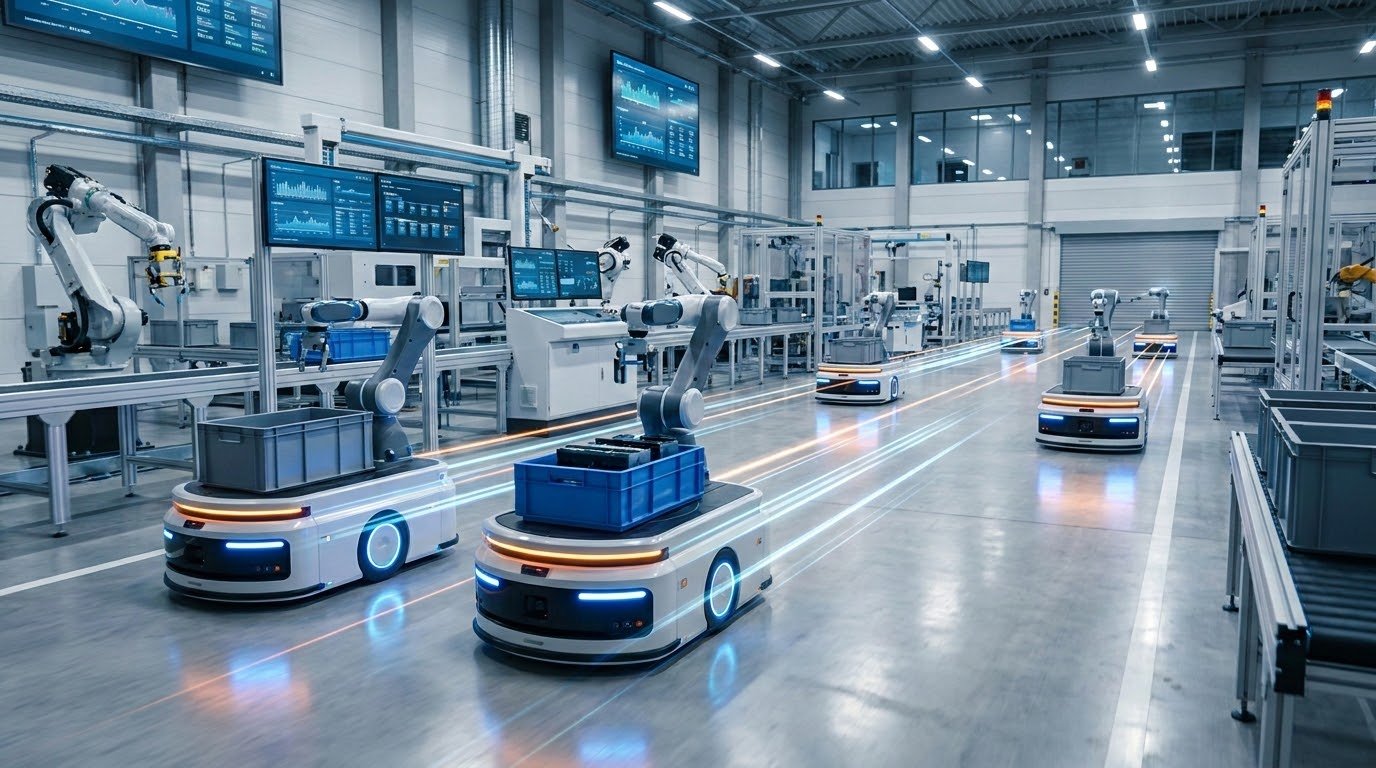
Autonomous mobile robots (AMRs) transport materials across factory floors. They navigate dynamically, avoiding obstacles and optimizing routes.
Unlike older automated guided vehicles (AGVs), which followed fixed paths, AMRs use sensors and AI to move freely.
Companies like Amazon have deployed thousands of these robots in their fulfillment centers.
But what’s happening inside factories is even more complex.
These robots don’t just move.
They coordinate.
They communicate.
They adapt.
A delay in one part of the system can trigger adjustments across the entire production line.
It’s not just automation.
It’s orchestration.
The Human Role Isn’t Disappearing—It’s Changing
At this point, it’s natural to ask: where do humans fit into all of this?
The answer is more nuanced than most headlines suggest.
Humans are not being eliminated from factories.
They are being repositioned.
Instead of performing repetitive physical tasks, workers are increasingly responsible for oversight, maintenance, and decision-making.
Collaborative robots—or cobots—are designed specifically to work alongside humans.
These machines handle physically demanding or monotonous tasks, allowing human workers to focus on more complex responsibilities.
Research from the International Federation of Robotics indicates that this hybrid model—human plus machine—is becoming the dominant structure in modern manufacturing.
And in many cases, it leads to higher productivity and safer working conditions.
Global Competition and the Race for Automation
Zoom out, and you’ll see that this transformation is not happening in isolation.
It’s part of a global competition.
Countries around the world are investing heavily in robotics and automation.
China, for example, has become the largest market for industrial robots, driven by its push toward advanced manufacturing.
The United States continues to lead in AI research and high-performance computing.
Europe is focusing on precision engineering and collaborative robotics.
This competition is shaping the future of global supply chains.
Factories are no longer just production centers.
They are strategic assets.
And the level of automation within a factory can directly impact a country’s economic competitiveness.

The Cost Equation: Why Now?
One of the reasons this shift is happening now comes down to economics.
Robots are becoming more capable.
AI is becoming more powerful.
And computing costs, while still significant, are becoming more manageable at scale.
At the same time, labor shortages are emerging in many regions.
Aging populations.
Changing workforce expectations.
Rising wages.
All of these factors are pushing companies to invest in automation.
According to industry data, global spending on industrial automation is expected to continue growing steadily over the next decade.
And as technology improves, the return on investment becomes increasingly attractive.
What the Factory of the Future Really Looks Like
So what does all of this add up to?
Imagine a factory where:
Machines monitor themselves.
Robots adjust their behavior in real time.
AI systems predict problems before they occur.
Autonomous vehicles coordinate logistics seamlessly.
Human workers oversee the system, intervening only when necessary.
This isn’t science fiction.
It’s already happening.
And the pace of change is accelerating.
So, where does this leave us?
If you’re trying to understand the future of robotics, don’t just look at the robots themselves.
Look at the systems they operate within.
Because modern factories are no longer just collections of machines.
They are intelligent networks.
And those networks are redefining how the world produces everything—from cars and electronics to medical devices and infrastructure components.
The next time you hold a product in your hands, it’s worth asking a simple question:
How much of this was made by humans—and how much was made by machines that are learning, adapting, and improving every day?
The answer, increasingly, is both.
And that balance may define the next era of industry.
References:
MIT Technology Review — https://www.technologyreview.com
McKinsey & Company — https://www.mckinsey.com
International Federation of Robotics — https://ifr.org
NVIDIA Industrial AI — https://www.nvidia.com/en-us/industries/manufacturing/
Thomas Huynh – Admin of RoboZone.top