
Hello everyone, today is Thursday, December 18, 2025.
The closer we get to the end of the year, the quieter the mornings feel. Fewer emails, fewer meetings, more time to actually think. Earlier today, while reviewing comments and emails sent to RoboZone.top, I noticed a recurring question from readers: “If robots are getting smarter every year, why do they still feel… limited?”
It’s a fair question. And it’s also one of the most misunderstood topics in modern robotics.
As Thomas Huynh, admin of RoboZone.top, I’ve spent years reading research papers, product manuals, and real-world user feedback. The answer isn’t that robots lack intelligence. It’s that they lack instinct — and that gap matters more than most people realize.

What Humans Call “Instinct” Is Actually Experience + Context
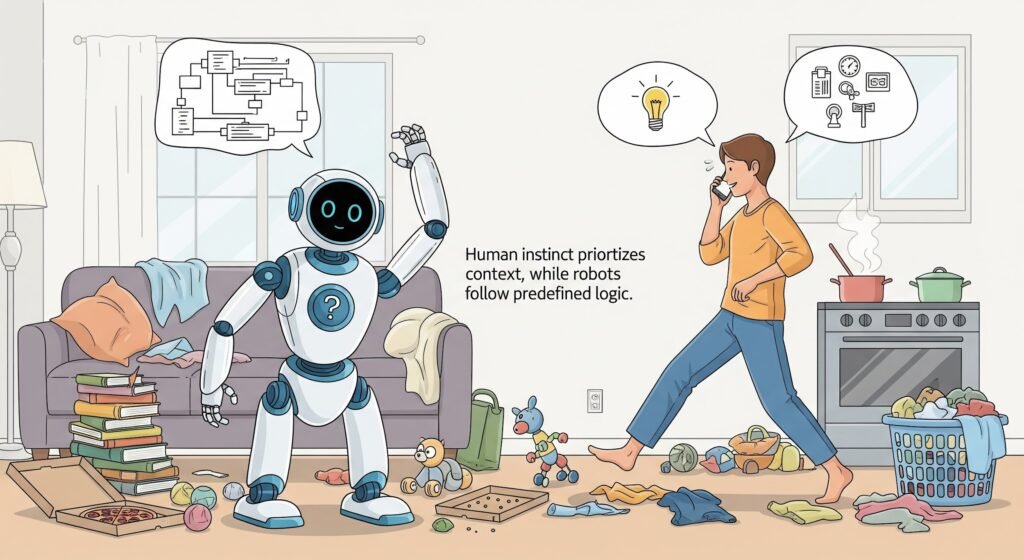
When humans walk into a messy room, we instantly prioritize. We don’t calculate probabilities. We feel what matters first. A spilled drink gets attention before scattered toys. A crying baby overrides everything.
Home robots don’t work that way.
Robots interpret the world through sensors, predefined rules, and statistical models. They don’t feel urgency. They calculate it. That difference may sound small, but in daily life, it changes everything.
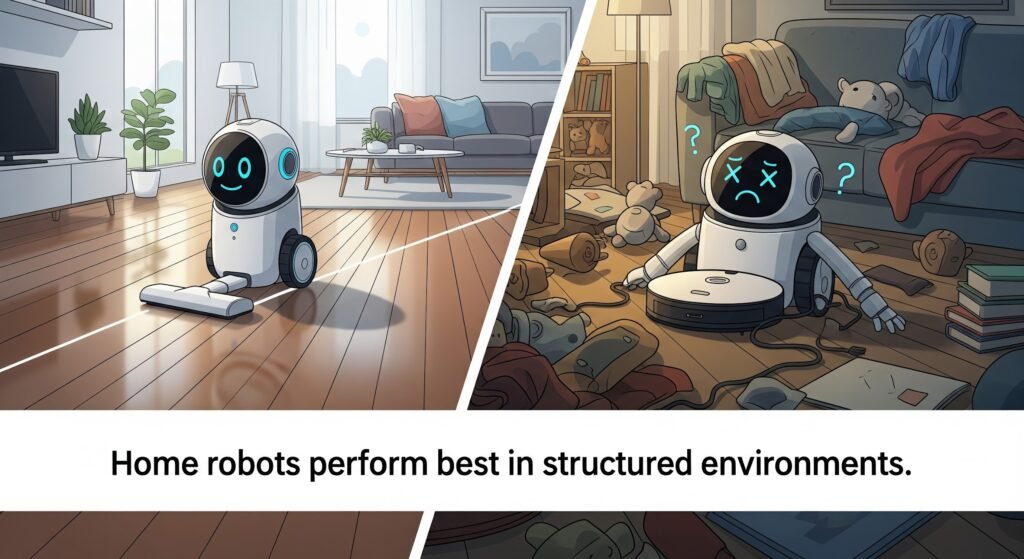
Even the most advanced home robots today still rely on structured environments. They perform best when reality behaves predictably — something humans rarely do.
Why This Limitation Is Not a Failure of AI
There’s a common belief that once AI becomes powerful enough, instinct will “emerge.” Research suggests otherwise.
Instinct isn’t raw intelligence. It’s the result of millions of years of evolution, embodied experience, and emotional feedback loops. Robots don’t grow up. They don’t develop fear, attachment, or intuition through lived experience.
Even with machine learning, robots optimize for goals we define. They don’t redefine goals on their own.
This is why most consumer robots still focus on narrow tasks: cleaning floors, mapping spaces, monitoring environments. The moment a task becomes ambiguous, performance drops sharply.
And that’s not a flaw. It’s a design boundary.
Why People Still Expect Too Much From Home Robots
Marketing doesn’t help. Product videos often show robots navigating perfect homes, free of chaos, pets, or unexpected behavior. Real life, however, is messy.
When expectations are set too high, disappointment feels inevitable. Many first-time users assume a robot will “figure things out” the way a human would. When it doesn’t, trust temporarily drops.
Ironically, long-term users tend to be more forgiving. They understand the robot’s role. They adapt their environment slightly. And once that balance is found, satisfaction increases.
This pattern shows up repeatedly in user studies and aligns closely with feedback shared by RoboZone.top readers.
The Real Future of Home Robotics Isn’t Replacement
Despite popular fears, home robots are not on a path to replace human judgment. They are on a path to support it.
The most successful robots don’t pretend to think like humans. They complement human behavior. They remove repetitive friction, not decision-making.
This is why hybrid systems — where robots handle execution and humans retain control — continue to dominate consumer robotics.
And honestly, that’s probably the healthiest outcome.

So Where Does This Leave Us Moving Forward?
If there’s one thing worth remembering, it’s this: robots don’t need instincts to be useful. They need clarity.
Clear tasks. Clear boundaries. Clear expectations.
The moment we stop expecting robots to behave like humans, and instead appreciate them for what they actually are, the experience improves dramatically.
As we head closer to 2026, the smartest move isn’t asking when robots will replace us. It’s asking how they can quietly make everyday life easier — without pretending to be something they’re not.
References & Further Reading
MIT Technology Review — Why AI Still Lacks Common Sense
IEEE Spectrum — Why Robots Struggle With Real-World Complexity
Stanford HAI — Human-Centered Artificial Intelligence and Robotics